







What's Happening?
California Governor Gavin Newsom has signed legislation aimed at accelerating the state's fusion energy industry and announced significant investments in quantum research. This move positions California as a leader in emerging technologies, focusing on both
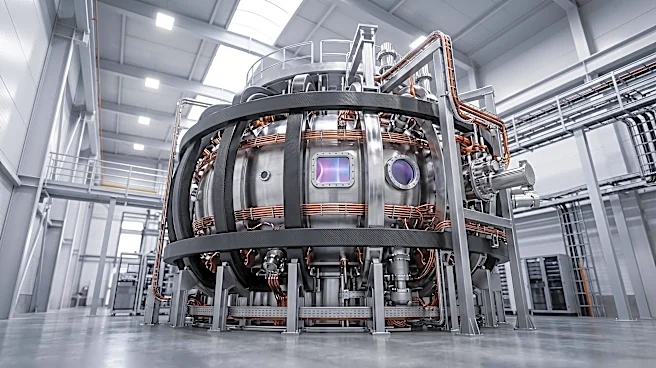
fusion and quantum as priority sectors under the California Jobs First Economic Blueprint. The legislation includes measures to create a strategic plan for fusion energy development, expand research opportunities, develop a commercial fusion strategy, and advance fusion manufacturing. Additionally, it mandates a comprehensive assessment of new nuclear power plants to help the state achieve 100% zero-carbon electricity by 2045. The state is leveraging its research capabilities, skilled workforce, and innovation economy to develop, test, and scale these technologies. California already leads the nation in quantum-skill job postings and semiconductor manufacturing jobs, and is home to numerous Nobel-winning breakthroughs in quantum science and technology. The state also boasts world-class talent with leading quantum computing research centers at various universities and tech giants.
Why It's Important?
This initiative is crucial for the United States' leadership in advanced technologies, as countries globally compete to dominate these fields. By strengthening its research, workforce, and innovation ecosystem, California aims to convert breakthrough ideas into new industries and high-paying jobs. Fusion energy, which powers the sun, offers the potential for a nearly limitless source of clean, reliable electricity, addressing critical energy needs and climate goals. Quantum computing, capable of solving complex equations in minutes that would take traditional computers thousands of years, holds immense potential for advancements in medication discovery, artificial intelligence, climate change modeling, and unhackable quantum communication networks. The state's investment in these areas is expected to create a robust economic ecosystem, potentially rivaling Silicon Valley, and ensure California remains at the forefront of scientific and technological innovation.
What's Next?
The newly signed legislation will lead to the development of a strategic plan for fusion energy in California, along with expanded research and development opportunities. A commercial fusion strategy will be developed, and efforts to advance fusion manufacturing will be undertaken. A comprehensive assessment of new nuclear power plants will also be conducted, incorporating public input, to evaluate their role in achieving the state's 2045 zero-carbon electricity goal. Furthermore, California will continue to support job creation through grants, including over $9.7 million for quantum workforce development and regional coordination. The National Science Foundation has also renewed its support for the UC Berkeley-led Challenge Institute for Quantum Computation with $37.5 million, extending its national mission for another five years, indicating continued federal and state investment in quantum research.
Beyond the Headlines
The long-term implications of California's aggressive push into fusion and quantum technologies extend beyond immediate economic and energy benefits. This strategic investment could fundamentally reshape the state's industrial landscape, fostering a new generation of high-tech industries and skilled jobs. Ethically, the development of unhackable quantum networks could revolutionize cybersecurity, offering unprecedented levels of data protection, but also raising questions about access and control. The potential for quantum computing to accelerate drug discovery and AI development could lead to significant societal advancements, but also necessitates careful consideration of the ethical frameworks governing these powerful tools. Culturally, California's continued leadership in innovation reinforces its identity as a global hub for technological progress, potentially attracting more talent and investment, and further solidifying its role in defining the future of science and technology.