








What's Happening?
Irregular migration from eastern Libya to the Greek island of Crete has significantly increased, with nearly 20,000 individuals attempting the crossing this year. This route, originating from Libya's east coast, particularly around Tobruk, has become
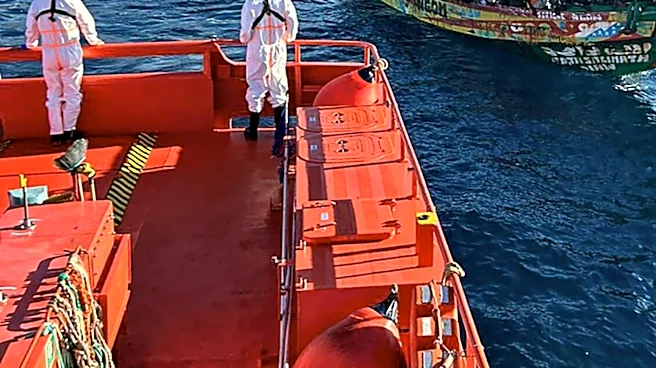
a major corridor for irregular migration into Europe. Greek authorities reported registering 710 people in 14 boats on October 20 alone, with hundreds more arriving the following day. Migrants reportedly pay up to $4,000 for the approximately day-and-a-half journey. This surge is partly attributed to crackdowns on alternative migration routes, such as those leading to Italy, which prompted smuggling networks to shift tactics to smaller boats heading towards Crete. The International Organization for Migration (IOM) reported that as of May and June this year, approximately 950,000 migrants and refugees were registered in Libya, many lacking access to healthcare or legal permits, increasing their vulnerability to exploitation.
Why It's Important?
The rise in irregular migration from eastern Libya to Crete highlights the evolving dynamics of human smuggling and its connection to Libya's 'conflict economy.' Armed actors gain economic resources and political influence by controlling informal markets and transport routes, including those used for human trafficking. This situation creates a complex challenge for European governments, which cooperate with Libyan entities to curb migration despite these entities' links to armed groups and their disputed political legitimacy. Such cooperation, while aiming to control migration, inadvertently enhances the local power of these Libyan actors, demonstrating their strategic importance to European governments. The precarious situation of migrants in Libya, as detailed by the IOM, underscores the humanitarian crisis and the urgent need for comprehensive solutions that address both security and human rights.
What's Next?
The continued surge in irregular migration is likely to intensify pressure on Greek authorities and the European Union to address the issue. This may lead to increased surveillance and interdiction efforts in the Aegean Sea. Furthermore, the geopolitical competition in the eastern Mediterranean, exemplified by the maritime agreement between the Tobruk government and Turkey, could further complicate efforts to manage migration flows. Experts suggest that irregular migrants could be used as leverage in these geopolitical conflicts, potentially leading to more complex diplomatic challenges. The EU will likely continue its cooperation with Libyan actors, despite the inherent contradictions, as it seeks to control migration at its source, while also facing scrutiny over the human rights implications of such partnerships.
Beyond the Headlines
The situation in eastern Libya reveals deeper implications regarding the intersection of migration, conflict, and geopolitical strategy. The 'conflict economy' in Libya, where various illicit activities including human smuggling thrive, is sustained by the instability and fragmentation of the country. This environment allows local power brokers to leverage migration flows for political influence and financial gain, presenting themselves as capable of restoring order to gain international support. The ethical dilemma for European nations lies in balancing migration control with the potential empowerment of actors involved in illicit activities. The long-term solution requires addressing the root causes of instability in Libya, fostering legitimate governance, and ensuring humanitarian protections for migrants, rather than solely focusing on interdiction, which often pushes smuggling networks to adapt and find new, often more dangerous, routes.