








What's Happening?
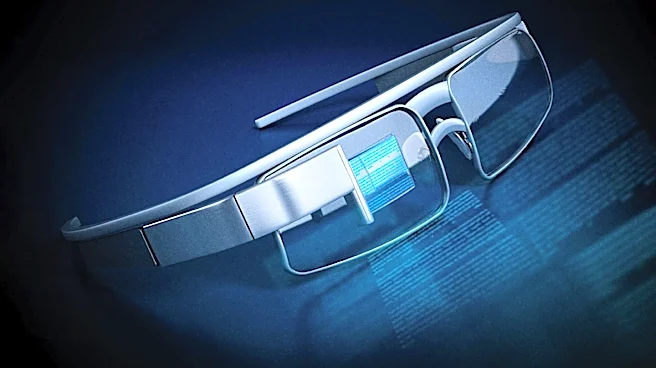
Smart glasses are increasingly being developed as assistive technology for individuals with hearing, sight, and memory impairments, despite growing privacy concerns related to their camera capabilities. Companies like Nuance Audio are creating smart glasses with arrays
of microphones and directional beamforming to amplify speech and reduce background noise for those with hearing loss, without relying on video. Other developers, such as Even Realities, are focusing on displaying conversation transcripts and providing translations. Physics-based simulation tools for AI are enhancing the development of these glasses, and new ultra-low power processors are improving performance and battery life. A UK project, COG-MHEAR, is developing 'hearing glasses' that use AI and lip-reading technology, including an RF-based system that can read lips through masks while preserving privacy by collecting only radio-frequency data.
Why It's Important?
The advancement of smart glasses as assistive technology holds significant promise for improving the quality of life for millions of Americans with disabilities. By offering solutions for hearing, vision, and cognitive challenges, these devices can enhance independence and participation in daily activities. However, the dual nature of this technology, particularly the use of cameras, presents a critical societal challenge regarding privacy. The public's perception of 'pervert glasses' and the potential for misuse could hinder the adoption of beneficial assistive devices. Balancing innovation with privacy protection is crucial for widespread acceptance and ensuring that these technologies serve their intended purpose without eroding trust or infringing on individual rights. The development of camera-free or privacy-preserving alternatives, like RF-based lip-reading, is vital for navigating this ethical dilemma.
What's Next?
The technology is rapidly evolving, with companies like CrossSense developing AI-powered smart glasses, such as 'Wispy,' to support individuals with dementia, with a commercial launch anticipated in early 2027. These glasses learn user habits and provide gentle prompts, aiming to enhance functional independence. Synaptics has also launched a new class of microcontrollers, the Astra SR200 Series, designed for AI wearables, enabling larger AI models to run on-device with improved power efficiency. These advancements suggest a future where smart glasses become more sophisticated, personalized, and integrated into daily life for assistive purposes. However, ongoing efforts will be needed to address privacy concerns and ensure responsible deployment, potentially through regulatory frameworks and public education campaigns.
Beyond the Headlines
The ethical and societal implications of smart glasses extend beyond immediate privacy concerns. The integration of AI into these devices raises questions about data security, algorithmic bias, and the potential for over-reliance on technology for cognitive functions. For instance, the 'Wispy' glasses for dementia patients, while beneficial, highlight the need for careful consideration of data consent models and the balance between assistance and surveillance. The shift towards on-device AI processing, as seen with Synaptics' new microcontrollers, could mitigate some privacy risks by reducing reliance on cloud-based data. Ultimately, the widespread adoption of smart glasses will necessitate a societal dialogue on the boundaries of technology in personal life, the definition of privacy in an augmented world, and the equitable access to these potentially life-changing tools.