
What's Happening?
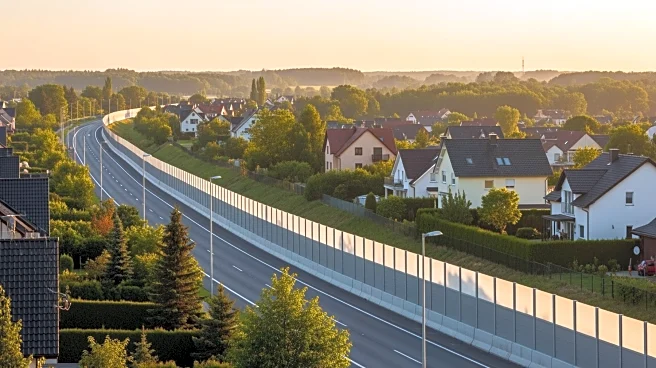
A recent study by the National Bureau of Academic Research has found that the construction of highway sound barriers significantly increases the value of nearby homes. By examining nearly 600,000 residential
properties in Florida, researchers discovered that homes within 1,000 feet of new sound barriers experienced a 6.8% increase in value over five years. The study highlights that noise reduction is a key factor in this value increase, with property values rising by nearly 1% for every decibel of traffic noise reduced. The research also suggests that traffic noise suppresses U.S. residential property values by approximately $110 billion.
Why It's Important?
The findings underscore the economic impact of noise pollution on residential property values, highlighting the potential benefits of investing in sound barriers. As urban areas continue to expand, reducing noise pollution could lead to significant financial gains for homeowners and communities. The study also points to the broader implications of noise reduction, such as improved quality of life and increased demand for quieter living environments. Additionally, the potential shift towards electric vehicles, which produce less noise, could further enhance property values, offering a substantial economic incentive for adopting cleaner transportation technologies.
What's Next?
The study's findings may encourage policymakers and urban planners to prioritize noise reduction measures in infrastructure projects. As the adoption of electric vehicles increases, the potential for further property value gains could drive more investment in sound barriers and other noise mitigation strategies. This could lead to a reevaluation of urban planning priorities, with a focus on creating quieter, more livable communities. The study also suggests that continued research into the economic impacts of noise pollution could inform future policy decisions and urban development strategies.