




What's Happening?
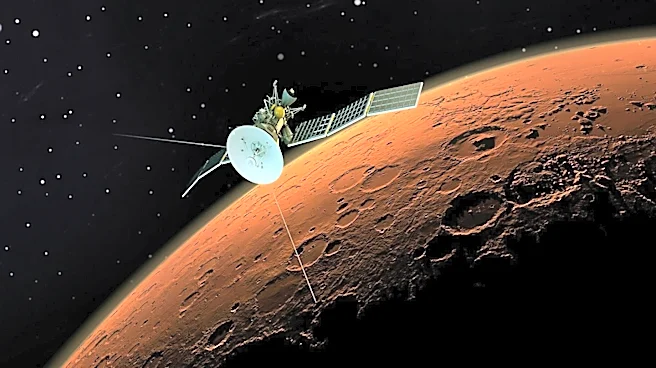
NASA's Psyche spacecraft successfully completed a flyby of Mars on May 15, using the planet's gravity to gain speed and adjust its trajectory towards the asteroid Psyche. This maneuver allowed the mission team to test the spacecraft's science instruments,
including the imager, magnetometer, and gamma-ray and neutron spectrometer. The instruments performed as expected, providing valuable data about Mars and demonstrating their capabilities for the upcoming asteroid mission. The flyby also offered a unique opportunity to capture detailed images of Mars, including its surface features and atmospheric conditions.
Why It's Important?
The successful Mars flyby is a critical milestone for the Psyche mission, as it validates the spacecraft's instruments and trajectory adjustments needed for its journey to the asteroid Psyche. This mission aims to study the metal-rich asteroid, believed to be the core of a planetesimal, to gain insights into the building blocks of rocky planets. The data collected during the flyby not only enhances our understanding of Mars but also ensures that the instruments are ready for the primary mission objectives. This preparation is essential for the mission's success and the advancement of planetary science.
What's Next?
Following the Mars flyby, the Psyche spacecraft will continue its journey towards the asteroid Psyche, with an expected arrival in 2029. The mission team will analyze the data collected during the flyby to refine their strategies for the asteroid encounter. The spacecraft will resume its solar-electric propulsion system later this fall, continuing its path through the solar system. As the mission progresses, scientists anticipate gaining unprecedented insights into the composition and history of the asteroid, contributing to our understanding of planetary formation and evolution.
Beyond the Headlines
The Psyche mission represents a significant step in exploring metal-rich asteroids, which could provide clues about the early solar system and the formation of terrestrial planets. The mission's innovative use of Mars for instrument calibration demonstrates the strategic planning and resourcefulness of NASA's mission teams. This approach not only maximizes the scientific return of the mission but also showcases the potential for future missions to leverage planetary flybys for similar purposes. The success of the Psyche mission could pave the way for more ambitious explorations of asteroids and other celestial bodies.