



What's Happening?
The Expedition 74 crew aboard the International Space Station (ISS) is actively engaged in innovative research focusing on stem cells and space technology. The crew, consisting of NASA astronauts, JAXA (Japan Aerospace Exploration Agency) members, and Roscosmos
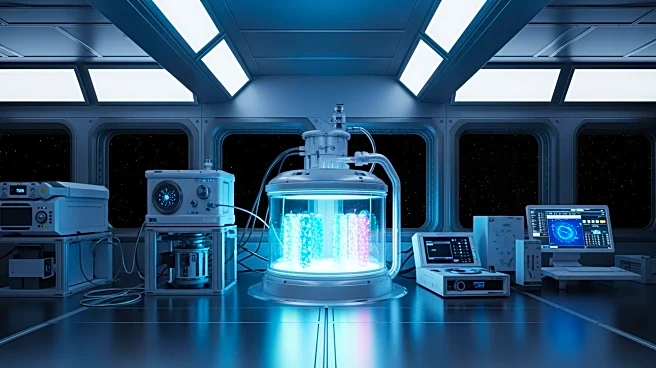
cosmonauts, is conducting experiments that could have significant implications for both space exploration and medical advancements on Earth. NASA Flight Engineer Zena Cardman is leading efforts in the Destiny laboratory module to produce stem cells in space, which may surpass the quality of those produced on Earth, potentially advancing regenerative medicine. Meanwhile, JAXA's Kimiya Yui is working on a materials exposure experiment in the Kibo laboratory module, aiming to test materials against space radiation and temperature extremes. This research is crucial for developing advanced life support systems for future lunar missions. The crew is also involved in various maintenance tasks, including cargo operations and equipment installations, to support ongoing and future missions.
Why It's Important?
The research conducted by the Expedition 74 crew is pivotal for several reasons. The successful production of superior stem cells in space could revolutionize regenerative medicine, offering new treatments for damaged organs and tissues. This advancement holds promise for medical industries on Earth, potentially leading to breakthroughs in healthcare. Additionally, the materials exposure experiment is essential for understanding how different materials withstand the harsh conditions of space, which is critical for the development of durable equipment for space exploration. These experiments not only enhance our understanding of space environments but also contribute to the preparation for future missions, such as NASA's Artemis program aimed at returning humans to the Moon. The outcomes of these studies could lead to technological innovations that benefit both space exploration and terrestrial industries.
What's Next?
As the Expedition 74 crew continues their research, the next steps involve analyzing the data collected from these experiments to draw meaningful conclusions. The results will inform future missions and the development of technologies for space exploration. The crew is also preparing for the departure of JAXA's HTV-X1 cargo spacecraft, which will return to Earth with valuable research samples and data. This ongoing research and collaboration among international space agencies underscore the importance of the ISS as a platform for scientific discovery and innovation. The findings from these experiments will likely influence the design and implementation of future space missions, including those targeting Mars and beyond.