
What's Happening?
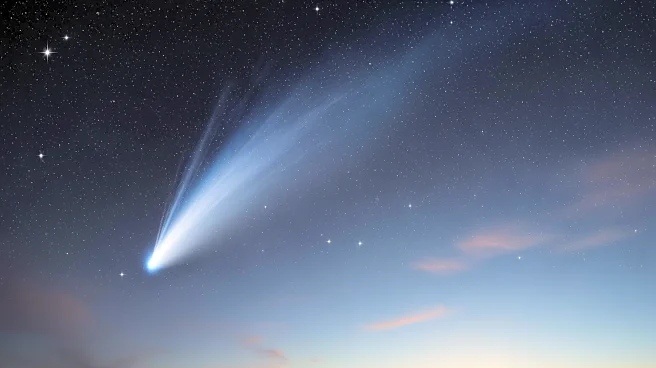
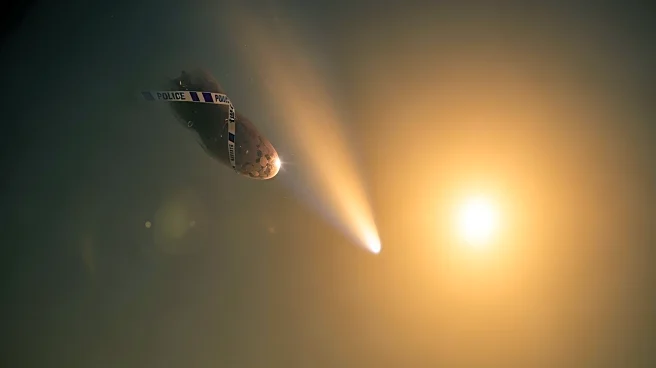
Comet 24P/Schaumasse is making its closest approach to the sun, known as perihelion, on January 8. Discovered in 1911 by astronomer Alexandre Schaumasse, this short-period comet orbits beyond Jupiter before
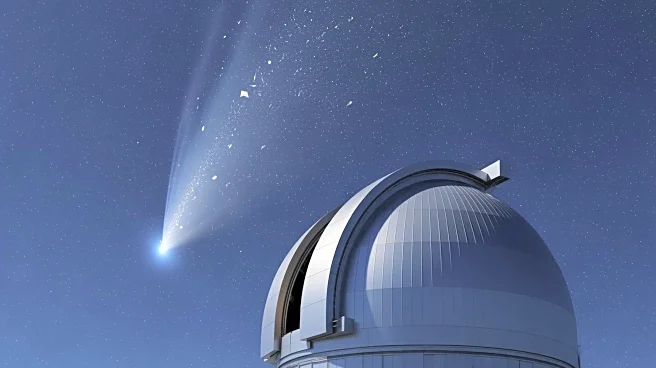
returning towards the sun approximately every eight years. As it nears the sun, the comet's icy material vaporizes, creating a bright coma that can sometimes be visible from Earth. However, with a current magnitude of +10.8, the comet is not visible to the naked eye and requires a telescope with at least a 6-inch aperture for observation.
Why It's Important?
The study of comets like 24P/Schaumasse provides valuable insights into the early solar system, as these celestial bodies are considered primordial remnants. Observing their behavior and composition helps astronomers understand the processes that shaped the solar system's formation. While this particular comet may not be visible without specialized equipment, its approach offers an opportunity for amateur and professional astronomers to study its characteristics and contribute to ongoing research in planetary science.
What's Next?
Astronomers and enthusiasts can attempt to observe 24P/Schaumasse using telescopes, particularly in the predawn hours when the comet is positioned near the constellation Virgo. The comet's visibility will be affected by the light of a waning gibbous moon, making it a challenging target. Future observations and data collection will continue to enhance our understanding of cometary behavior and their role in the solar system. As technology advances, new methods and tools may improve the ability to study such distant objects.