

What's Happening?
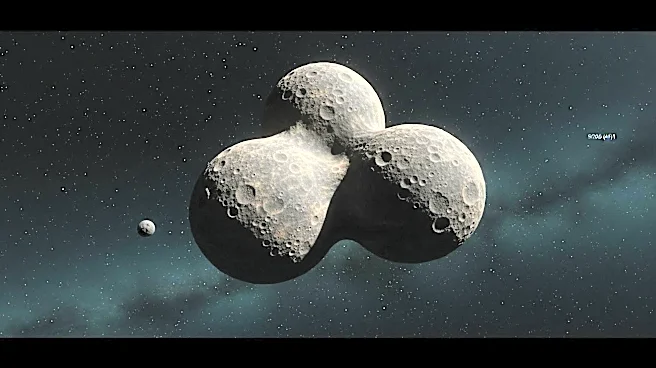
An international team of astronomers, led by Kate Minker of Lowell Observatory, has identified asteroid (44) Nysa as the first confirmed three-lobed asteroid ever imaged. This discovery, detailed in their paper 'Unmasking (44) Nysa: Evidence for a Trilobate
Structure' posted on arXiv, challenges previous assumptions about asteroid formation. Until now, all known asteroids with distinct 'necks' or narrow waists, formed by the accumulation of smaller bodies, were observed to have exactly two lobes. Nysa, a 75-kilometer body in the main asteroid belt, was found to have two prominent valleys wrapping around its circumference, effectively dividing it into three connected sections. The observations were made using ground-based instruments, SHARK-VIS on the Large Binocular Telescope in Arizona and SPHERE/ZIMPOL on the European Southern Observatory’s Very Large Telescope in Chile, which employ adaptive optics to achieve spacecraft-quality imaging resolution from Earth. Additionally, the team discovered a small moon, provisionally designated S/2026 (44) 1, orbiting Nysa, a feature previously uncatalogued despite Nysa being a well-studied object since 1857.
Why It's Important?
This discovery is significant because it directly impacts the understanding and modeling of small body formation in the solar system. Existing formation models for contact binaries have largely been built and tested on the two-lobed pattern, which was considered a reasonable working assumption given all prior observations. Nysa's trilobate structure introduces an exception that necessitates a re-evaluation or expansion of these models. It suggests that the processes leading to the formation of these bodies might be more complex or varied than previously thought, potentially involving different collision scenarios or accumulation mechanisms. The finding also highlights the limitations of earlier observational techniques, as Nysa's complex shape and moon remained undetected for over a century despite its brightness and extensive tracking. This implies that other seemingly two-lobed asteroids might also possess more subtle, unresolved features that could be revealed with improved imaging technology, potentially leading to further revisions in asteroid classification and formation theories.
What's Next?
Researchers will now focus on refining formation models to accommodate the existence of three-lobed asteroids like Nysa. This will involve exploring two primary hypotheses: whether Nysa is a 'contact trinary' formed from the re-accumulation of three fragments from an earlier collision, or if it is the remnant of a larger parent body that underwent a high-speed 'hit-and-run' collision. Distinguishing between these scenarios will likely require data on Nysa's internal density and composition, which ground-based imaging cannot currently provide. Future observations with even more advanced instruments or potential spacecraft missions could offer the necessary data to resolve this question. Furthermore, astronomers will likely re-examine other previously cataloged two-lobed asteroids with higher resolution imaging to determine if any also possess a hidden third lobe or other complex structures that have gone unnoticed. This could lead to a broader understanding of the prevalence of such complex asteroid shapes and their implications for solar system evolution.
Beyond the Headlines
The ability to achieve spacecraft-quality imaging from ground-based telescopes, as demonstrated by the observations of Nysa, represents a significant technological leap in astronomy. This advancement allows for detailed study of distant celestial bodies without the immense cost and logistical challenges of space missions. It opens new avenues for discovering and characterizing objects in our solar system, potentially revealing more unexpected structures and phenomena. The case of Nysa also underscores a broader scientific principle: that even well-studied objects can hold hidden complexities that are only unveiled as observational technology improves. This continuous refinement of our tools and methods can lead to fundamental shifts in scientific understanding, challenging long-held assumptions and prompting new lines of inquiry. The discovery of Nysa's moon, alongside its unusual shape, further emphasizes the dynamic and often surprising nature of asteroid systems, suggesting that many more secrets may still be held within the main asteroid belt.