





What's Happening?
NASA is preparing to launch the Nancy Grace Roman Space Telescope as early as September 2026, ahead of its initial commitment to launch by May 2027. The telescope, which is currently at NASA's Goddard Space Flight Center in Maryland, is set to be delivered
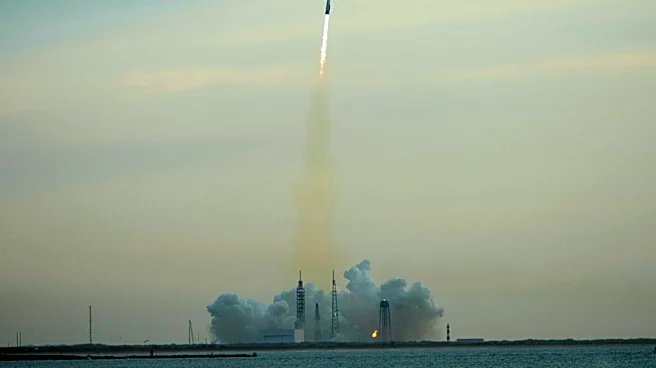
to the Kennedy Space Center in Florida by June. The Roman Space Telescope is designed to explore dark energy, dark matter, and exoplanets, offering a wide field of view and infrared vision to survey large areas of the sky. The mission aims to create a 20,000-terabyte data archive over its five-year primary mission, enabling the study of 100,000 exoplanets, millions of galaxies, and billions of stars. The launch will be conducted using a SpaceX Falcon Heavy rocket from Launch Complex 39A at the Kennedy Space Center.
Why It's Important?
The Roman Space Telescope represents a significant advancement in astronomical research, providing unprecedented observational capabilities. Its ability to survey vast areas of the sky with high precision will enhance our understanding of the universe, particularly in the study of dark energy and dark matter, which are critical to understanding the universe's expansion. The mission's data archive will be a valuable resource for scientists worldwide, potentially leading to new discoveries about the cosmos. The collaboration between NASA and SpaceX also highlights the growing role of private enterprise in space exploration, which could lead to more efficient and cost-effective missions in the future.
What's Next?
NASA and SpaceX will continue to prepare for the launch, with further updates on the specific launch date and prelaunch preparations expected. The successful launch and operation of the Roman Space Telescope could pave the way for future missions that leverage similar technologies and partnerships. The scientific community will be closely monitoring the mission's progress, as the data collected could influence future research directions and priorities in astronomy and astrophysics.