
What's Happening?
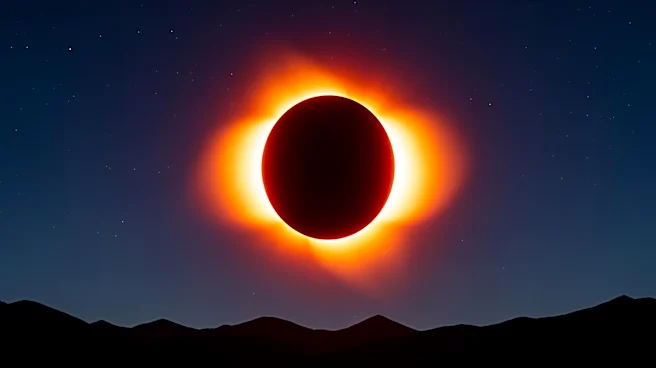
A total solar eclipse is set to occur on August 12, 2026, visible across parts of Greenland, Iceland, northern Russia, and the Atlantic Ocean, with a partial eclipse observable in parts of the northern U.S.,
Canada, Europe, and northwestern Africa. During the eclipse, the Moon will completely cover the Sun for a brief period, offering a rare celestial event for those in the path of totality. Observers outside this path will experience a partial eclipse, where the Moon covers only part of the Sun.
Why It's Important?
Total solar eclipses are rare events that provide unique opportunities for scientific observation and public engagement with astronomy. They allow scientists to study the Sun's corona and other solar phenomena that are otherwise obscured by the Sun's brightness. For the public, eclipses offer a chance to witness a dramatic natural event, often sparking interest in astronomy and science. The 2026 eclipse will be particularly significant for regions that rarely experience such events, potentially boosting tourism and educational activities.
What's Next?
As the date approaches, preparations for viewing events and educational programs will likely increase. Observers are advised to use proper eye protection when viewing the eclipse to prevent eye damage. The event may also prompt further research into solar and atmospheric sciences, as scientists take advantage of the opportunity to gather data during the eclipse.