




What's Happening?
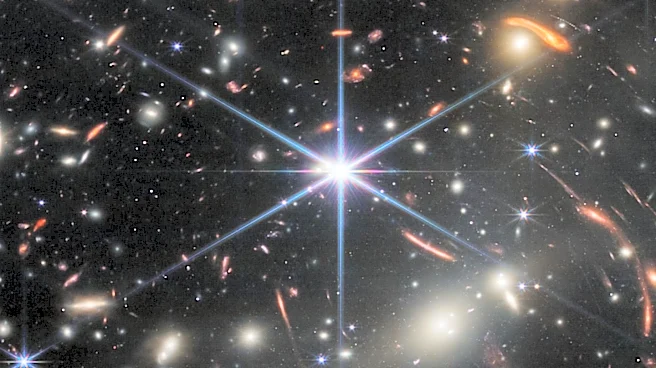
New research indicates that early galaxies, specifically compact, crimson-hued objects dubbed 'Little Red Dots' (LRDs) discovered by the James Webb Space Telescope, could be the source of high-energy neutrinos detected on Earth. These LRDs, existing between
0.6 and 1.6 billion years after the Big Bang, are believed to harbor rapidly growing supermassive black holes (SMBHs) at their centers, making them early-universe quasars. Neutrinos, often called 'ghost particles' due to their minimal interaction with matter, are detected by observatories like the IceCube Neutrino Observatory. The origin of this all-sky neutrino background has been a long-standing mystery in astrophysics. The study, led by Riku Kuze of Kyoto University, proposes that the dense gaseous envelopes surrounding these LRDs could absorb gamma rays while allowing neutrinos to escape, thus explaining the discrepancy between observed gamma-ray and neutrino backgrounds. This theory aligns with several observed properties of LRDs, including their compact morphologies, 'V-shaped' spectral energy distributions indicating obscuration, and lack of strong radio or X-ray signatures.
Why It's Important?
This research is significant for several reasons, primarily advancing the field of multi-messenger astrophysics by linking optical and infrared observations from the James Webb Space Telescope to neutrino detections on Earth. If confirmed, this hypothesis would provide crucial insights into the formation and growth of the first supermassive black holes, a process that remains poorly understood. The direct-collapse black hole model, while theoretically attractive, has been difficult to test observationally. The identification of LRDs as potential neutrino factories offers a new diagnostic tool, allowing scientists to constrain the physical conditions within these objects by comparing neutrino background properties with model predictions. This interdisciplinary approach bridges two cutting-edge frontiers in modern science, potentially resolving a long-standing astrophysical enigma and refining our understanding of the early universe and fundamental particle physics.
What's Next?
The research team has outlined several crucial next steps to further validate their hypothesis. One key area is the prediction and measurement of the neutrino flavor ratio, which refers to the relative proportions of electron, muon, and tau neutrinos. This ratio carries a distinctive imprint of the production mechanism and can help differentiate LRDs from other proposed neutrino sources. Additionally, the team aims to model the conditions under which jets become concealed within the gaseous envelopes of LRDs, a process likely influenced by the Eddington accretion rate and the compactness of the surrounding gas cloud. Ongoing James Webb Space Telescope surveys will continue to expand the catalog of LRDs, providing better constraints on their number density and luminosity distribution. Future upgrades to the IceCube detector, such as the planned IceCube-Gen2 extension, are expected to dramatically increase sensitivity, potentially detecting subtle features in the neutrino spectrum predicted by these models. Facilities like the Extremely Large Telescope (ELT) may also enable direct spectroscopic studies of individual LRDs.
Beyond the Headlines
The potential confirmation of LRDs as neutrino sources extends beyond astrophysics, touching upon fundamental physics and our understanding of the universe's earliest moments. The 'ghostly' nature of neutrinos, allowing them to traverse vast cosmic distances unimpeded, makes them unique messengers from obscured regions of space that electromagnetic radiation cannot penetrate. This research highlights the power of indirect observation in unraveling cosmic mysteries, where the absence of one type of signal (gamma rays) combined with the presence of another (neutrinos) can paint a more complete picture. It underscores the interconnectedness of various scientific disciplines, from cosmology and particle physics to observational astronomy, in pushing the boundaries of human knowledge. The ongoing quest to understand the high-energy neutrino background is not just about identifying sources but also about testing the limits of the Standard Model of particle physics and exploring the extreme conditions that prevailed in the universe's infancy.