

What's Happening?
A new study led by the University of Cambridge suggests that comets likely did not deliver the molecular building blocks necessary for life to begin on Earth. Published in the journal Scientific Reports, the research indicates that the entry of comets into
Earth's atmosphere is too violent for prebiotic molecules, such as hydrogen cyanide (HCN), to survive intact. Lead author Richard Anslow noted that while the idea of comets acting as a 'get out of jail free card' for life's molecules is romantic, simulations show that the conditions required for these molecules to survive atmospheric entry and impact are extremely rare, making it a 'one-in-a-million occurrence' at best. Even if some molecules survived, they would not be in sufficient quantities to significantly contribute to prebiotic chemistry. This challenges the pseudo-panspermia hypothesis, which posits that life's building blocks originated from space and were delivered to Earth by celestial bodies.
Why It's Important?
This study significantly impacts the scientific understanding of abiogenesis, the process by which life arose from non-living matter on Earth. If comets are largely ruled out as a primary source of initial organic molecules, scientists will need to further explore alternative terrestrial mechanisms for the formation of these crucial compounds. This shift in understanding could redirect research efforts in astrobiology and planetary science, influencing how scientists search for the origins of life on Earth and potentially on other planets. The findings also underscore the extreme conditions present during Earth's early history and the complex interplay of factors required for life to emerge, potentially making the origin of life seem even more unique to Earth or requiring different extraterrestrial delivery mechanisms than previously considered.
What's Next?
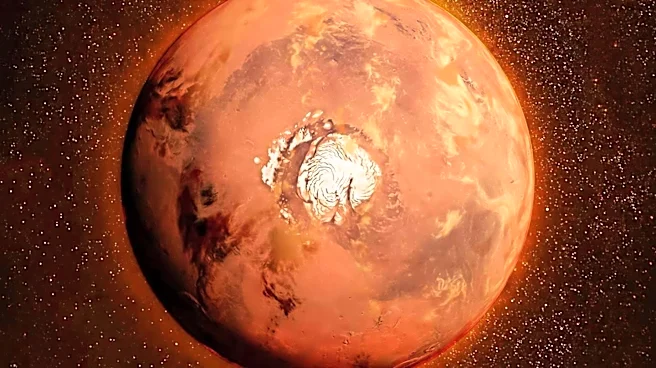
The findings will likely prompt further research into alternative theories for the origin of life on Earth, focusing more on endogenous processes or other extraterrestrial delivery methods that could withstand atmospheric entry. Scientists may investigate other celestial bodies, such as asteroids, or explore different types of atmospheric entry scenarios. The study also suggests that while unlikely for Earth, comets might have been more effective at seeding life-giving molecules on planets with thinner atmospheres, like Mars. This could lead to renewed interest in Martian astrobiology and missions aimed at understanding the potential for life's origins on other planets within our solar system, considering their atmospheric conditions and geological histories.
Beyond the Headlines
The study's implications extend beyond the scientific community, touching upon philosophical questions about the uniqueness of life on Earth and the probability of life elsewhere in the universe. If the delivery of life's building blocks via comets is indeed highly improbable, it might suggest that the conditions for abiogenesis are even more specific and rare than previously thought, potentially making Earth a more exceptional case. Conversely, it could also spur investigations into more robust mechanisms for the formation of complex organic molecules within planetary environments themselves, highlighting the planet's own chemical capabilities. This research contributes to the ongoing debate about whether life is a common cosmic phenomenon or a rare occurrence, influencing our perspective on humanity's place in the universe.