



What's Happening?
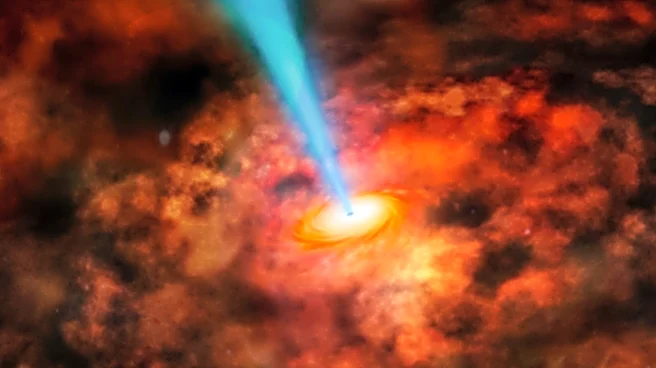
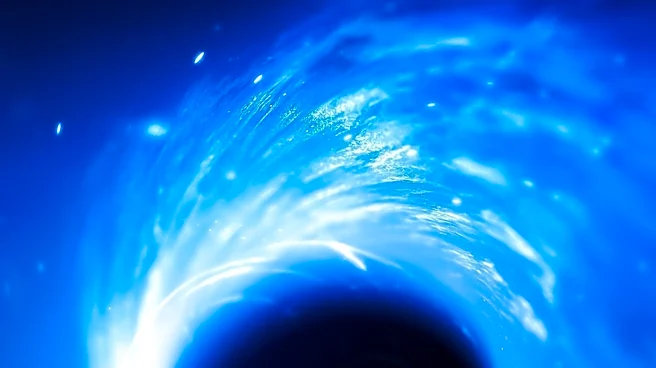
Astronomers have identified a pattern consistent with supermassive black holes being ejected from the centers of galaxies following mergers. A study analyzing 104,688 quasars, published in Monthly Notices of the Royal Astronomical Society, found that
quasars with larger estimated black-hole velocity offsets tend to appear redder due to obscuring dust. This observation aligns with predictions from earlier simulations regarding black holes displaced by gravitational waves. The research, led by Bence Bécsy of Eötvös Loránd University in Hungary, focused on identifying a shared signature across a large population of quasars rather than confirming individual runaway black holes. While the measurements do not directly track black holes moving through space, they compare light from different regions around quasars and use color as an indicator of dust, providing a natural explanation for recoiling black holes, though other physical processes could also contribute to the observed pattern.
Why It's Important?
This discovery is significant for understanding the dynamics of galactic evolution and the behavior of supermassive black holes. The ejection of these massive objects from galactic centers, if confirmed, would provide crucial insights into the aftermath of galaxy mergers and the role of gravitational waves in shaping cosmic structures. It could also help explain the distribution of black holes throughout the universe and their interaction with surrounding gas and stars. The statistical approach used in this study, examining a large population of quasars, offers a new methodology for detecting phenomena that are difficult to observe directly. This research contributes to a broader understanding of general relativity and its observational consequences on a cosmic scale, potentially refining models of black hole growth and galactic formation.
What's Next?
Further investigation is needed to definitively prove that the observed pattern is solely due to recoiling black holes. Researchers plan to repeat the analysis using other broad spectral features and improve dust estimates through more refined spectral analysis. Establishing whether the same pattern persists under these new tests will help distinguish genuine black-hole recoil from other phenomena, such as moving gas and measurement biases. If confirmed, this research could provide a complementary method to future gravitational wave observatories like the Laser Interferometer Space Antenna (LISA), offering a way to study the frequency of supermassive black hole mergers. Improved population models are also necessary to translate the observed correlation into reliable estimates of past merger rates.
Beyond the Headlines
The potential for supermassive black holes to be ejected from galactic centers raises profound questions about the long-term stability of galaxies and the fate of their central engines. Such ejections could have significant implications for the distribution of matter and energy within galaxies, potentially influencing star formation rates and the evolution of galactic nuclei. The study also highlights the challenges of observational astronomy, where indirect evidence and statistical analysis are often necessary to infer complex cosmic processes. The ongoing effort to differentiate between various physical mechanisms that could produce similar observational signatures underscores the intricate nature of astrophysical research and the continuous refinement of theoretical models based on new data.