


What's Happening?
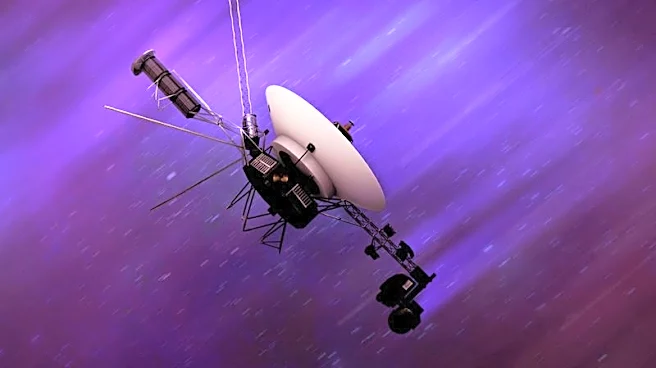
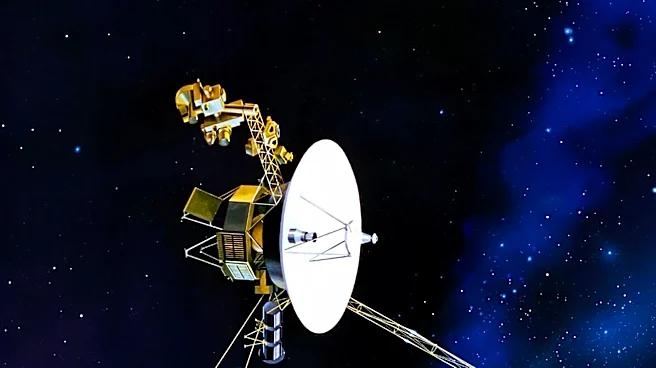
Pasadena, California, is joining a worldwide salute to NASA's Voyager 1 spacecraft as it approaches a milestone: reaching a distance from Earth equal to one full day of light travel. On November 17, 2026, Caltech will host 'Shine Bright for Voyager at
Caltech' outside Beckman Auditorium, inviting residents to raise lights to the evening sky. This event coincides with NASA's global invitation for people to create a 'symbolic wave of golden light' after sunset. The milestone is predicted for 2:16:07 a.m. Pacific time on November 18, when Voyager 1, the most distant human-made object, will be approximately 16.1 billion miles (25.9 billion kilometers) from Earth. At this distance, a radio signal takes a full day to travel from Earth to the spacecraft and another full day to return.
Why It's Important?
This milestone for Voyager 1 is a testament to human ingenuity and perseverance in space exploration. The spacecraft, built and operated by NASA's Jet Propulsion Laboratory (JPL), has been traveling for nearly 50 years, providing invaluable scientific observations from interstellar space. Its continued operation, despite power limitations and the vast distances involved, pushes the boundaries of engineering and scientific understanding. For the U.S., the Voyager mission represents a significant achievement in its space program, inspiring public interest in science and technology. The public celebration in Pasadena and worldwide underscores the global impact of such missions, fostering a shared sense of wonder and encouraging future generations to pursue careers in space science and engineering.
What's Next?
Following the lighting event, NASA will host a moderated discussion on November 19 at JPL's von Kármán Auditorium, streamed online. The discussion will feature mission members and NASA leadership, who will talk about the status of Voyager 1 and Voyager 2, the science they continue to gather in interstellar space, and the engineering challenges of maintaining operations over such immense distances. A question-and-answer session will follow, along with a preview of an upcoming NASA+ Voyager documentary scheduled for release in 2027, coinciding with the mission's 50th anniversary. Engineers continue to implement power-saving changes to extend the operational life of both Voyager spacecraft, aiming to keep them going for as long as possible.
Beyond the Headlines
The Voyager mission transcends its scientific achievements, embodying humanity's innate drive to explore the unknown. The 'Golden Record' carried by both spacecraft, containing sounds and images of Earth, serves as a message to any potential extraterrestrial intelligence, representing a profound act of interstellar communication. As Voyager 1 ventures further into interstellar space, it becomes a symbol of our species' enduring curiosity and our capacity for long-term vision. The public's participation in events like the 'Shine Bright for Voyager' celebration highlights the emotional connection people have to these missions, recognizing them not just as scientific endeavors but as a collective human journey into the cosmos, pushing the boundaries of our understanding and imagination.