




What's Happening?
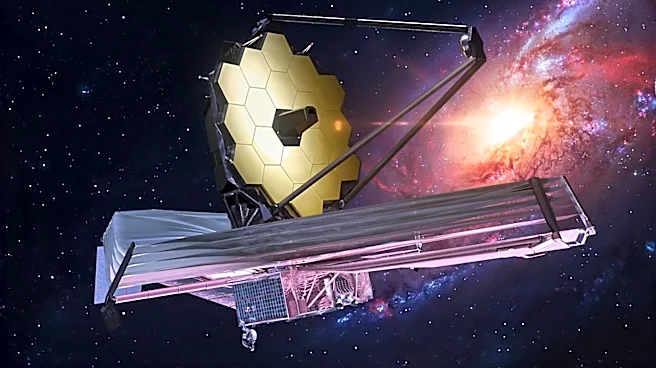
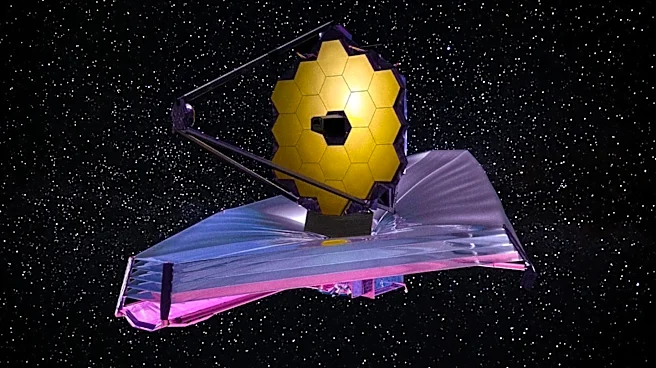
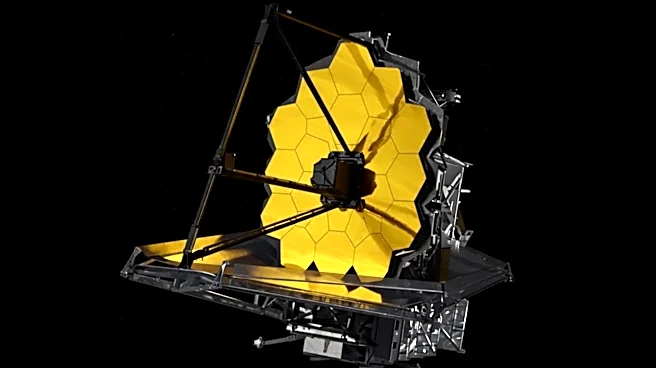
The James Webb Space Telescope (JWST) has provided the first direct confirmation of variable water clouds on a celestial body outside our solar system. Scientists observed WISE 0855, a brown dwarf located 7.5 light-years away, for 11 hours, collecting
spectral data every 15 minutes. This detailed time-series portrait revealed that high-altitude water clouds on WISE 0855 thicken and thin as the object rotates, a phenomenon akin to weather patterns on Earth. Additionally, the study identified gases like carbon monoxide and phosphine being brought to the upper atmosphere by convection from the brown dwarf's interior, a process also observed on Jupiter. This capability to distinguish between cloud dynamics and atmospheric chemistry marks a significant advancement, previously impossible with older telescopes that blended these effects.
Why It's Important?
This discovery is crucial for understanding planetary atmospheres beyond our solar system. By observing real-time changes in water clouds and atmospheric chemistry on WISE 0855, scientists can gain insights into the universal physics governing convection, cloud formation, and chemical processes on gas giants. Although brown dwarfs are not planets, their planet-like atmospheric behaviors provide a valuable analog for studying gas giant exoplanets, which astronomers are increasingly investigating with the JWST. The ability to separate distinct atmospheric signals allows for a more nuanced understanding of how these distant worlds function, blurring the lines between brown dwarfs and planets and highlighting shared fundamental physical and chemical principles across diverse celestial bodies.
What's Next?
Researchers plan to conduct additional baseline observations with the James Webb Space Telescope to further refine details about WISE 0855's rotation and the three-dimensional intricacies of its atmospheric motion. These future observations aim to provide a more comprehensive understanding of the brown dwarf's weather systems and how they evolve over time. The insights gained from WISE 0855 are expected to inform studies of other gas giant exoplanets, helping astronomers develop more accurate models of their atmospheres and potential habitability. The ongoing use of JWST's advanced spectrograph will continue to push the boundaries of exoplanetary atmospheric characterization, revealing more about the diverse weather phenomena occurring across the galaxy.
Beyond the Headlines
The detection of dynamic weather patterns on WISE 0855 underscores the universality of atmospheric physics, suggesting that the same fundamental principles governing weather on Earth and Jupiter extend to distant, free-floating celestial bodies. This finding has broader implications for astrobiology, as understanding atmospheric conditions is a prerequisite for assessing the potential for life beyond Earth. While WISE 0855 is not considered habitable, the methodology used to study its atmosphere can be applied to exoplanets within habitable zones, potentially revealing the presence of water clouds or other atmospheric features indicative of life-supporting environments. This research also highlights the transformative power of the James Webb Space Telescope in providing unprecedented detail about exoplanetary systems.