




What's Happening?
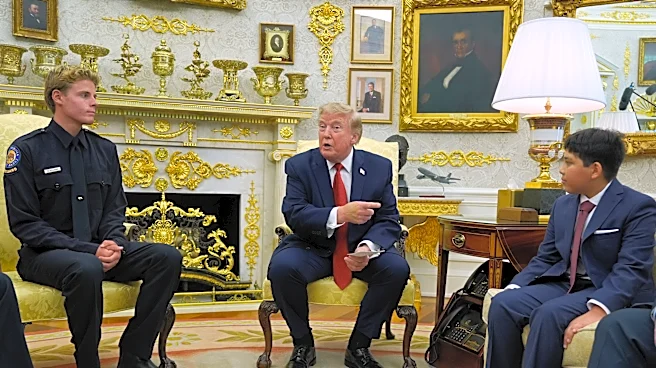
President Donald Trump's previous two-word comment describing Representative Nancy Mace's tattoos as 'freaky' has resurfaced following her recent reveal of nine new tattoos. Mace, a Republican from South Carolina, showcased her new body art while promoting
her 'Get Maced' podcast on YouTube. She explained that she got the tattoos to experience 'the pain I need to feel' and to 'reclaim' her body and identity after a staff exodus and a breakup. Mace dismissed the significant attention her tattoos have garnered, stating that it is not a major political event and urging people to relax, emphasizing that 'This is not a coup. There were no classified documents released. This wasn't even the dumbest thing Washington has ever done before lunch.' The lawmaker is set to leave the House at the end of the current term, having previously had a disagreement with President Trump regarding the Jeffrey Epstein files.
Why It's Important?
The resurfacing of President Trump's comment and the subsequent public reaction to Representative Mace's new tattoos highlight the ongoing scrutiny faced by public figures, particularly women, regarding their personal appearance and choices. This situation underscores the intersection of personal expression and political perception, where even non-political aspects of a lawmaker's life can become subjects of public debate and media attention. For Representative Mace, her decision to get new tattoos and her explanation behind them offer a glimpse into her personal journey of reclaiming identity, which can resonate with or alienate different segments of the public. The incident also reflects the broader political landscape where personal details can be weaponized or trivialized, diverting attention from policy discussions and legislative work. The differing reactions, ranging from derision to applause, illustrate the polarized nature of public opinion and the challenges politicians face in managing their public image.
What's Next?
While Representative Mace has downplayed the significance of the attention on her tattoos, the discussion is likely to continue in various online and media forums. Her upcoming departure from the House at the end of the current term suggests that this incident, while generating buzz, may not have long-term political ramifications for her legislative career. However, it could influence public perception of her as she transitions out of her current role. The event may also prompt further discussions within political circles and the media about the appropriate boundaries of commentary on politicians' personal lives and appearances. For other public figures, this situation could serve as a case study on how personal choices are scrutinized and interpreted in the public eye, potentially influencing their own decisions regarding personal expression.
Beyond the Headlines
Beyond the immediate headlines, this event touches upon deeper societal norms and expectations placed on public figures, particularly women in politics. The intense focus on Representative Mace's tattoos, and President Trump's past comment, can be seen as a manifestation of a culture that often scrutinizes and judges women based on their appearance rather than solely on their professional contributions. Her statement about reclaiming her body and identity through the tattoos speaks to a broader theme of personal autonomy and self-expression in the face of public pressure. This incident also highlights the evolving nature of political discourse, where social media amplifies personal stories and reactions, sometimes overshadowing substantive policy debates. The trivialization of such personal matters by some, contrasted with the lawmaker's own explanation, underscores the ongoing tension between public and private lives for those in the political arena.