



What's Happening?
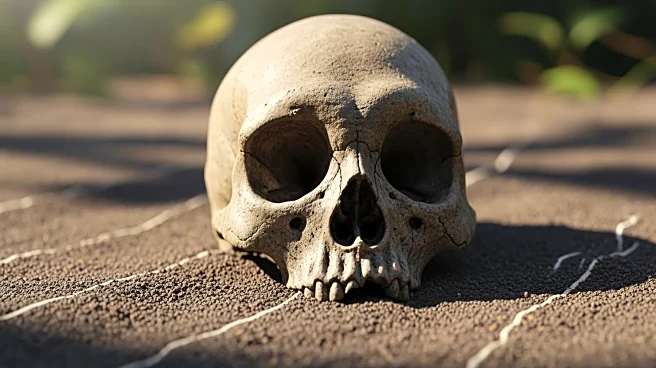
In 2025, significant progress was made in understanding the Denisovans, a mysterious group of ancient humans first identified from a 60,000-year-old pinkie finger bone found in Siberia. The discovery of a skull in Harbin, China, known as 'Dragon Man,'
has provided new insights into this enigmatic population. Genetic analysis of the skull's dental calculus revealed Denisovan DNA, linking it to this ancient group. This finding is crucial as it offers a physical representation of the Denisovans, whose existence was previously known only through genetic traces in modern humans. The skull, estimated to be 146,000 years old, has been attributed to a new species, Homo longi, and is believed to be a Denisovan ancestor. This discovery has energized the scientific community, providing a clearer picture of Denisovan anatomy and their place in human evolution.
Why It's Important?
The identification of the Denisovan skull is a major breakthrough in paleoanthropology, offering tangible evidence of a group that has long been a genetic mystery. This discovery enhances our understanding of human evolution, particularly the interactions between ancient human species. The Denisovans are known to have interbred with Homo sapiens, contributing to the genetic makeup of modern humans, especially in Asia. Understanding their physical characteristics and evolutionary history can provide insights into human adaptation and migration patterns. This research also highlights the potential for further discoveries in the field, as more Denisovan remains may be identified using the new genetic links established by the Dragon Man skull.
What's Next?
Future research will likely focus on identifying additional Denisovan fossils and further analyzing the genetic material from the Dragon Man skull. Scientists aim to build a more comprehensive picture of Denisovan life, including their habitat, behavior, and interactions with other human species. The discovery of another skull in China, yet to be fully analyzed, could provide further insights into the Denisovan lineage. As researchers continue to explore these ancient connections, new revelations about human evolution are expected, potentially reshaping our understanding of how modern humans evolved and adapted over time.
Beyond the Headlines
The discovery of the Denisovan skull raises intriguing questions about the diversity of ancient human species and their interactions. It challenges previous assumptions about human evolution and highlights the complexity of our ancestry. The potential identification of 'ghost lineages'—ancient human groups not yet found in the fossil record—suggests that our understanding of human history is still incomplete. This discovery underscores the importance of interdisciplinary research, combining genetics, archaeology, and anthropology to uncover the secrets of our past.