
What's Happening?
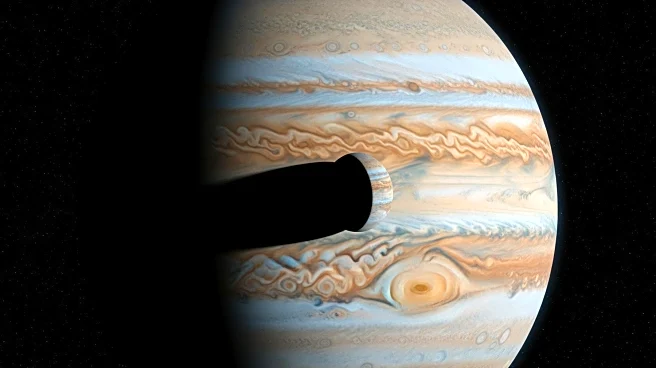
On the night of December 6th to 7th, a significant astronomical event will occur as Europa, one of Jupiter's moons, and its shadow transit across the planet's disk. This event is visible to observers in
the eastern United States, with Europa's shadow appearing at 11:54 P.M. EST and the moon itself beginning its transit at 1:31 A.M. EST on December 7th. Jupiter, located in eastern Gemini, will be visible to the naked eye despite the bright waxing Moon nearby, but a telescope is necessary to observe the detailed transits of its moons. Earlier in the evening, Io, another of Jupiter's moons, and its shadow will also transit the planet, providing a double feature for skywatchers.
Why It's Important?
This event is significant for both amateur and professional astronomers as it provides an opportunity to observe the dynamics of Jupiter's moons and their interactions with the planet. Such transits offer insights into the orbital mechanics and physical characteristics of these celestial bodies. For the general public, it is a chance to engage with astronomy and appreciate the complexity and beauty of our solar system. The visibility of such events can inspire interest in space science and encourage educational activities related to astronomy.
What's Next?
Following this event, observers can look forward to Mercury reaching its greatest western elongation on December 7th, making it visible in the eastern predawn sky. These consecutive astronomical events provide ongoing opportunities for observation and study. For those interested in further celestial events, keeping track of astronomical calendars and updates from observatories can provide information on upcoming transits, eclipses, and other phenomena.