






What's Happening?
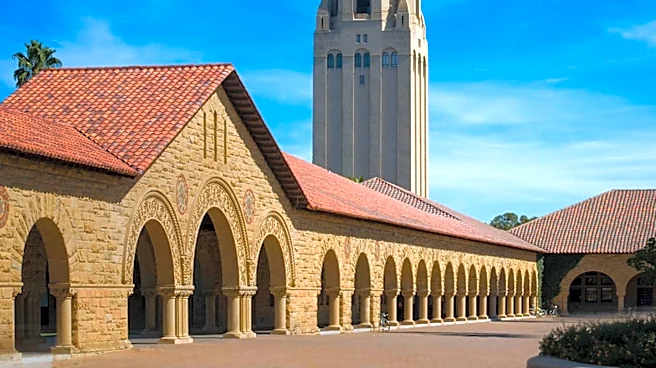
Supreme Court Justice Clarence Thomas, 78, recently stated that institutions like Stanford Law School are "presumptively off limits" to conservatives such as himself, implying an unwelcoming environment. He made these remarks during a forum at the Hoover
Institution, a public policy think tank located at Stanford University, which focused on the legacy of conservative intellectual Thomas Sowell. Justice Thomas expressed that conservative views are often deemed "unpalatable" in such academic settings, leading to animosity. In response, a Stanford spokesperson quickly refuted his claim, stating that the university "would be honored to host Justice Thomas at Stanford Law School." The spokesperson further noted that the Stanford Constitutional Law Center regularly hosts members of the judiciary and that students and faculty would welcome the opportunity to engage with his perspectives.
Why It's Important?
This exchange highlights a recurring debate about intellectual diversity and freedom of speech within academic institutions, particularly concerning conservative viewpoints. Justice Thomas's comments reflect a perception among some conservatives that certain universities are hostile to their ideas, potentially stifling open discourse. Stanford's swift invitation, however, aims to counter this narrative, emphasizing its commitment to intellectual engagement across the political spectrum. This situation is important because it touches upon the role of universities as forums for diverse thought and the challenges of fostering an inclusive environment for all perspectives. It also underscores the ongoing cultural and political polarization affecting various sectors of American society, including higher education.
What's Next?
Following Stanford's public invitation, the next step would be for Justice Thomas to decide whether to accept the offer to speak at Stanford Law School. If he accepts, his appearance would likely be a high-profile event, drawing significant attention and potentially sparking further discussions about intellectual diversity on campus. It would also provide an opportunity for direct engagement between a prominent conservative legal figure and the university community. If he declines, it could reinforce the perception that he believes the environment remains unwelcoming, despite the official invitation. The situation will continue to be a point of discussion regarding academic freedom and political representation in higher education.
Beyond the Headlines
The incident delves into the broader issue of perceived ideological homogeneity in academia and the challenges of fostering genuine intellectual pluralism. Justice Thomas's remarks, even if disputed by Stanford, tap into a sentiment among some that conservative voices are marginalized or unwelcome in certain elite educational spaces. This perception can contribute to a sense of alienation and further entrench political divides. Stanford's response, while offering an olive branch, also serves to defend its reputation as an institution open to diverse viewpoints. The underlying tension speaks to the ongoing struggle within society to bridge ideological gaps and ensure that all perspectives can be heard and debated respectfully in public forums.