









What's Happening?
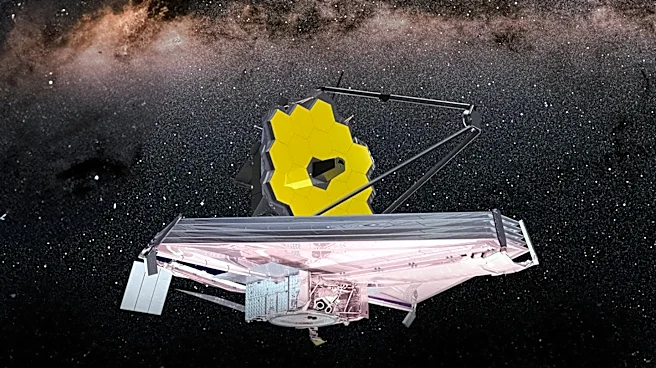
Astronomers from the University of Utah have made a groundbreaking discovery by identifying the first stellar-mass black hole in the massive globular star cluster Omega Centauri. Utilizing archival data from NASA's Hubble Space Telescope and recent observations
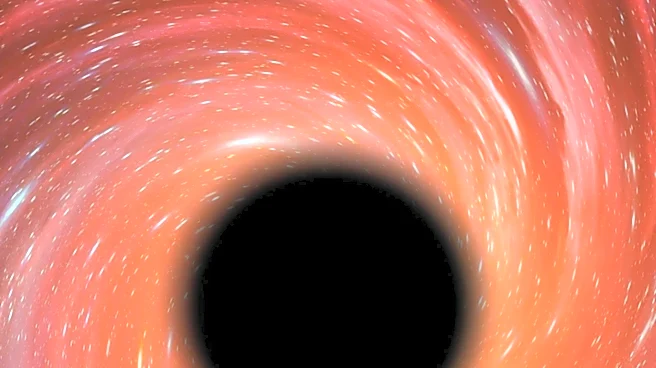
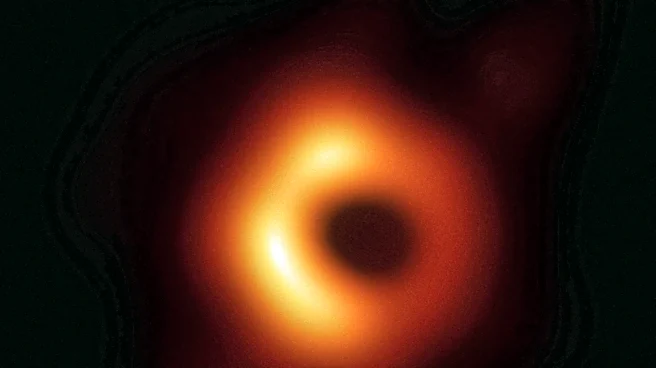
from the James Webb Space Telescope, the team employed astrometry to detect the black hole. This method involved measuring minute movements of stars over time, leading to the identification of a star orbiting an invisible, massive object, confirmed to be a black hole. Dubbed oMEGACat BH-2, this black hole is notable for its lower-than-expected mass and its long orbital period with a visible star companion, the longest known for any black hole binary system.
Why It's Important?
This discovery challenges existing theories about black hole formation in environments like Omega Centauri, which is composed of 10 million gravitationally bound stars. The identification of oMEGACat BH-2 provides new insights into the dynamics of such clusters and the potential for finding more black holes within them. The research also highlights the capabilities of the Hubble and Webb telescopes in advancing our understanding of cosmic phenomena. The findings could influence future studies on black hole formation and the evolution of star clusters, offering valuable data for modeling these processes.
What's Next?
The research team plans to continue their exploration of Omega Centauri and other star clusters using the Hubble and Webb telescopes. They are also looking forward to the launch of NASA's Nancy Grace Roman Space Telescope, which will provide regular, high-resolution imaging of the galactic bulge, potentially uncovering more black hole binary systems. This ongoing research could significantly enhance our understanding of black hole populations and their formation in different cosmic environments.