



What's Happening?
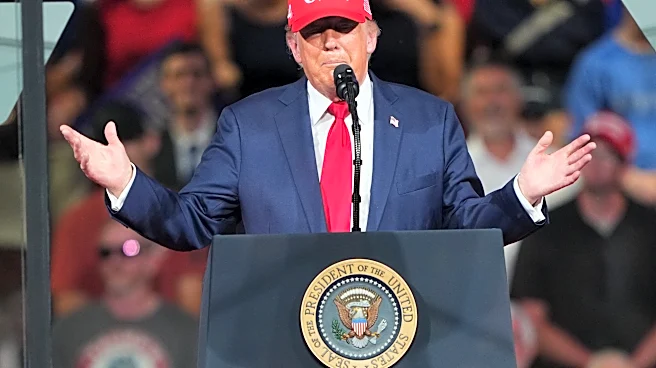
U.S. President Trump's administration is actively dismantling the post-war global order's emphasis on the inviolability of international borders, according to an opinion piece. President Trump has repeatedly expressed expansionist ambitions, such as sharing
a map where the American flag covers numerous countries, including Canada, Cuba, and Greenland. He has also mused about annexing Canada, calling the border an 'artificially drawn line,' and directed the U.S. Board on Geographic Names to rename the Gulf of Mexico to the 'Gulf of America' and Lake Ontario to 'Lake America.' These actions, while not yet resulting in new U.S. territories, have normalized the concept of territorial revisionism. His threats to 'take back' the Panama Canal reportedly led Panama to limit China's presence and authorize an increased U.S. military presence. Furthermore, after deploying troops to Venezuela and capturing its president, Nicolás Maduro, President Trump indicated the U.S. would 'run' the country, leading to a deal that gives the U.S. control over significant Venezuelan oil reserves. This approach has emboldened other nations to pursue their own territorial claims.
Why It's Important?
The U.S. shift away from upholding territorial integrity has significant implications for global stability and international relations. By normalizing territorial revisionism, President Trump's policies could encourage other powerful nations to pursue their own expansionist agendas, potentially leading to increased geopolitical instability and conflicts. For instance, the article suggests that China could apply similar justifications for claims in Taiwan, the Senkaku Islands, and the South China Sea, while Russia could do the same in Ukraine. The U.S.'s actions also impact its allies, as seen with Argentina's President Javier Milei, a Trump ally, reviving the dispute over the Falkland Islands and strengthening Argentina's naval presence. The U.S. administration's perceived disregard for established international norms could weaken alliances and create a more unpredictable global landscape, where territorial disputes are more likely to escalate without a strong international consensus against such actions. This could lead to a breakdown of diplomatic solutions and an increase in military posturing.
What's Next?
The normalization of territorial revisionism by the U.S. administration under President Trump is likely to continue influencing international relations and territorial disputes globally. Other countries, observing the U.S. approach, may feel emboldened to press their own territorial claims more aggressively. For example, Morocco, having seen President Trump recognize its sovereignty over Western Sahara, may continue to assert claims over Spanish enclaves like Ceuta and Melilla. The article highlights that the U.S. House Appropriations Committee has already described Ceuta and Melilla as 'Spanish-administered territories located in Moroccan territory' and called for negotiations on their 'future status,' indicating potential U.S. involvement in reframing such disputes. This trend suggests a future where established borders are increasingly contested, potentially leading to more frequent diplomatic tensions, border crises, and even military confrontations as nations test the limits of this new geopolitical environment. The long-term impact could be a significant reordering of global territorial boundaries and a weakening of international law.
Beyond the Headlines
The deeper implications of President Trump's territorial revisionism extend beyond immediate geopolitical shifts, touching upon fundamental principles of international law and sovereignty. The U.S., traditionally a proponent of the post-World War II order that emphasized territorial integrity, is now perceived as undermining this very foundation. This shift could lead to a 'might makes right' mentality, where powerful nations feel less constrained by international norms and more inclined to use force or coercion to achieve territorial gains. The ethical dimension is significant, as it questions the moral authority of the U.S. on the global stage and its commitment to peaceful resolution of disputes. Culturally, it could foster a climate of distrust and resentment among nations, particularly those whose sovereignty is challenged. In the long term, this could lead to a more fragmented and volatile international system, where the risk of interstate conflict is heightened, and the mechanisms for collective security are weakened. The erosion of respect for international borders could also have profound effects on global trade, migration, and resource allocation, creating new challenges for international cooperation.