

What's Happening?
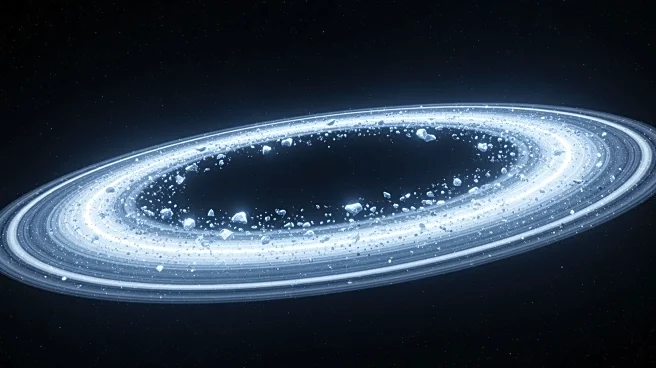
A new cluster of objects has been discovered within the Kuiper belt, a region of icy bodies beyond Neptune. Led by Amir Siraj from Princeton University, the research identified a compact group of Kuiper belt objects (KBOs) with unusually round orbits.
This discovery challenges existing models of the solar system's formation and dynamics. The inner kernel, a tight clump of KBOs, was found alongside a known cluster, raising questions about the gravitational influences and historical movements of planets like Neptune. The study utilized advanced clustering methods to analyze orbital data, revealing patterns that were previously unnoticed.
Why It's Important?
The discovery of this new structure in the Kuiper belt has significant implications for our understanding of the solar system's formation and evolution. It suggests that Neptune's migration may have played a more complex role in shaping the orbits of KBOs than previously thought. This finding could lead to revisions in dynamical models that simulate planetary movements and interactions. Understanding these patterns is crucial for astronomers as they provide insights into the early solar system and the processes that led to the formation of planets and other celestial bodies.
What's Next?
Further observations and data collection are needed to confirm the nature of the newly discovered cluster and its relationship to Neptune's gravitational influence. The upcoming surveys by the Vera C. Rubin Observatory are expected to provide more detailed information on KBOs, potentially revealing additional clusters and refining existing models. Researchers will continue to analyze the data to understand the implications of this discovery on the solar system's history and dynamics.