
What's Happening?
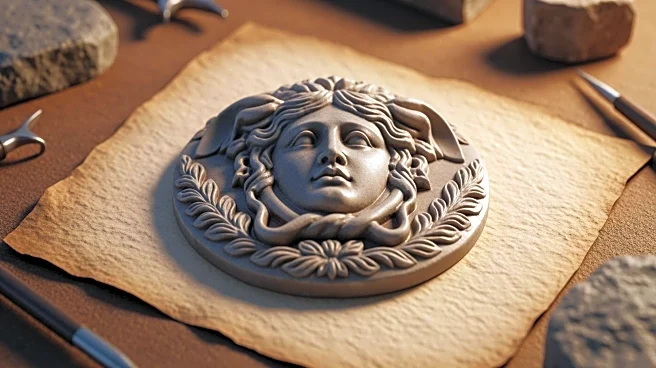
A rare Roman cameo relief depicting the goddess Medusa has been unearthed at a construction site in Hallstatt, Austria. The artifact, a finely carved banded agate relic, was discovered during excavation
work for a new funicular railway system. The cameo, dating back to the 2nd century C.E., is considered one of the most significant finds from antiquity in Upper Austria. It was likely crafted in a northern Adriatic workshop and sold as jewelry, possibly worn by an elite Roman woman. The discovery was made by ARDIS Archäologie GmbH and the Upper Austrian State Culture Company, in collaboration with Salzwelten GmbH. The piece will be displayed at the Cultural and Congress House in Hallstatt before becoming part of the permanent collection at Linz Castle Museum.
Why It's Important?
The discovery of the Medusa cameo is significant as it provides insight into the cultural and historical context of the Roman presence in Upper Austria. It highlights the region's rich archaeological heritage and the interconnectedness of ancient European societies. The find enriches the understanding of Roman craftsmanship and trade, as well as the social status of individuals who might have owned such artifacts. It also underscores the importance of archaeological work in uncovering historical artifacts that contribute to the broader narrative of human history.
What's Next?
The Medusa cameo will be displayed at the Cultural and Congress House in Hallstatt and later become part of the permanent archaeology collection at Linz Castle Museum. This will allow scholars and the public to engage with the artifact, fostering a deeper appreciation of the region's historical significance. The ongoing construction and archaeological work in Hallstatt may lead to further discoveries, enhancing the understanding of the area's ancient past.
Beyond the Headlines
The discovery of the Medusa cameo also raises questions about the preservation and presentation of cultural heritage. It highlights the role of modern infrastructure projects in uncovering historical artifacts and the need for careful planning to balance development with heritage conservation. The find may inspire further archaeological interest and research in the region, potentially leading to new insights into the Roman era and its influence on contemporary European culture.