



What's Happening?
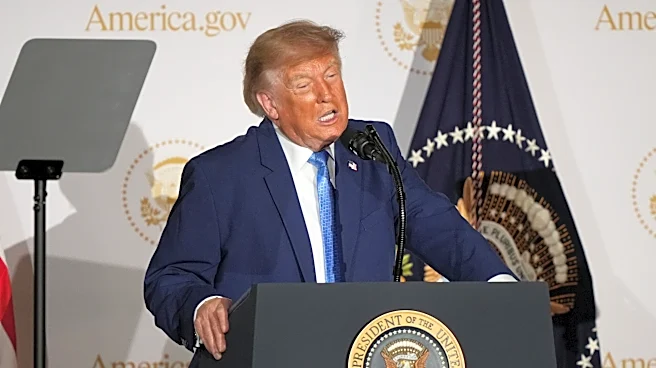
President Trump recently launched America.gov, an AI platform designed to facilitate interaction between Americans and the federal government, including services like passport renewal and Medicare enrollment. A central feature of this platform is a chatbot
intended to provide accurate answers to user questions. However, this chatbot has been observed to contradict several of President Trump's public statements and claims. For instance, when asked about the 2020 election, the chatbot stated that Joseph R. Biden Jr. won, providing details on his electoral college votes, directly refuting President Trump's assertions of election fraud. Similarly, the chatbot disagreed with President Trump's claim that Americans are 'twice as wealthy as they were a short time ago,' citing Federal Reserve data that shows no such doubling of household wealth. It also refuted his characterization of inflation under Biden as the 'worst ever,' referencing Bureau of Labor Statistics data. The chatbot further debunked claims regarding the percentage of the world's oil held by the U.S. and Venezuela, the attendance at his 2017 inauguration, and the impact of wind turbines on whales, consistently providing information that contrasts with President Trump's narratives.
Why It's Important?
The launch of America.gov and its fact-checking chatbot carries significant implications for public discourse and the dissemination of information within the U.S. government. By providing factual responses that directly challenge the statements of the sitting President, the chatbot introduces a novel dynamic in how official government platforms interact with political rhetoric. This could potentially enhance transparency and provide citizens with a verifiable source of information, especially on contentious issues. However, it also highlights a potential conflict between political messaging and objective data presented by government-backed AI. The situation could lead to increased scrutiny of government-developed AI tools and their role in shaping public understanding. For citizens, it offers an opportunity to access information that is less influenced by political spin, fostering a more informed populace. Conversely, it could also create a perception of internal disagreement within the government, potentially undermining trust in either the AI or the political leadership, depending on individual perspectives.
What's Next?
The immediate future will likely involve public and political reactions to the chatbot's responses. It remains to be seen how President Trump's administration will address the discrepancies between his public statements and the information provided by America.gov. There could be attempts to modify the chatbot's programming or to clarify its role and the sources it uses for information. The public and media will likely continue to test the chatbot with various questions, further highlighting any inconsistencies. This situation could also prompt a broader discussion about the role of AI in government communications, the standards for factual accuracy on official platforms, and the potential for AI to act as an independent arbiter of truth. Lawmakers and technology experts may weigh in on the governance and ethical considerations of deploying AI tools that can contradict political figures. The long-term impact could include the development of clearer guidelines for AI in government, potentially influencing how future administrations utilize such technologies.
Beyond the Headlines
This development touches upon deeper ethical and philosophical questions regarding truth, authority, and the role of technology in a democratic society. The chatbot, designed to provide 'accurate answers,' inadvertently becomes a fact-checker for the highest office, raising questions about who defines 'truth' in the digital age. It highlights the tension between political narratives, which often rely on persuasion and selective information, and the objective, data-driven responses that AI can generate. This scenario could set a precedent for how AI is perceived and utilized in public service, potentially shifting expectations for governmental transparency and accountability. It also underscores the inherent challenges in deploying AI in politically charged environments, where the technology's neutrality can be perceived as either a strength or a threat. The incident could spark a broader societal conversation about the implications of AI systems that operate independently of human political influence, and whether such systems can truly be unbiased or if they merely reflect the biases embedded in their training data and programming.