







What's Happening?
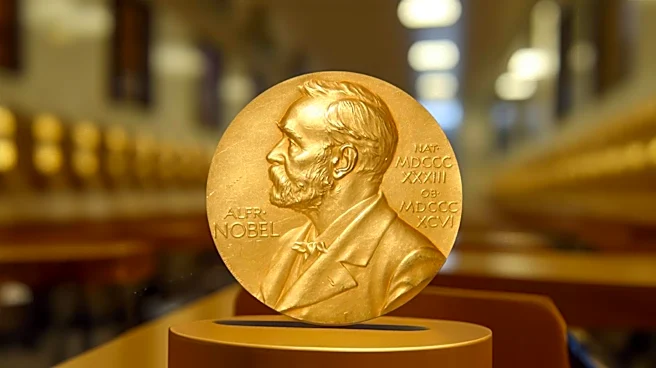
For the first time, two Chinese nationals, Wang Hong and Deng Yu, have been awarded the prestigious Fields Medal, often referred to as the 'Nobel Prize' of mathematics. This achievement is celebrated across China as a significant milestone in the country's
scientific and technological advancement. Wang, a professor at New York University, was recognized for her work in harmonic analysis and geometric measure theory, while Deng, a University of Chicago professor, was honored for his contributions to partial differential equations. Their success is seen as a breakthrough for Chinese mathematics and a testament to the country's growing influence in global scientific research.
Why It's Important?
The awarding of the Fields Medal to Wang and Deng highlights China's increasing prominence in the global scientific community. It reflects the country's efforts to become a leader in science and technology, aligning with its national goals of innovation and academic excellence. This recognition may inspire further investment in education and research within China, encouraging more young scholars to pursue careers in mathematics and other STEM fields. Additionally, it challenges stereotypes about China's capabilities in fundamental scientific research, potentially altering perceptions in Western academia.
What's Next?
China may continue to invest in its educational and research institutions to attract and retain top talent, addressing the issue of 'brain drain' where scholars leave for opportunities abroad. The success of Wang and Deng could motivate more Chinese students to pursue advanced studies in mathematics, contributing to the country's long-term scientific goals. There may also be efforts to encourage these scholars to return to China to teach and mentor the next generation of mathematicians.

)

