






What's Happening?
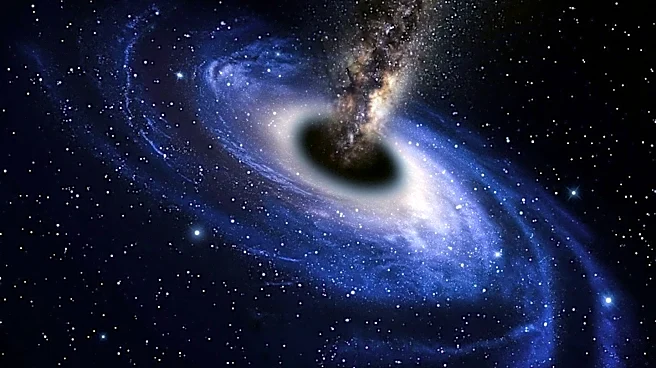
Researchers at the University of Miami have proposed that a recent gravitational wave detection by the Laser Interferometer Gravitational-Wave Observatory (LIGO) may provide evidence for the existence of primordial black holes. These black holes, theorized
to have formed shortly after the Big Bang, could potentially explain the nature of dark matter, which constitutes about 85% of the universe's matter. The detection involved an unusual gravitational wave signal that could not be explained by conventional stellar evolution, suggesting the presence of a primordial black hole. This theory builds on the work of Soviet scientists Yakov Zeldovich and Igor Novikov, and later Stephen Hawking, who expanded on the idea that these black holes could be abundant and emit radiation.
Why It's Important?
The potential confirmation of primordial black holes as a component of dark matter could revolutionize our understanding of the universe's structure and composition. Dark matter plays a crucial role in the formation and stability of galaxies, and identifying its constituents has been a major goal in astrophysics. If primordial black holes are confirmed, it could provide a tangible explanation for dark matter, influencing future research and technology in gravitational wave astronomy. This discovery could also validate decades-old theories and open new avenues for exploring the universe's early conditions.
What's Next?
Further detections by LIGO and its international partners are necessary to confirm the existence of primordial black holes. Planned upgrades to LIGO will enhance its sensitivity, increasing the likelihood of detecting additional candidate events. Future observatories, such as the European Space Agency's Laser Interferometer Space Antenna (LISA) and the proposed Cosmic Explorer in the United States, aim to extend the reach of gravitational wave detection back to the universe's earliest epochs. These advancements could provide more definitive evidence of primordial black holes and their role in the universe.
Beyond the Headlines
The implications of confirming primordial black holes extend beyond astrophysics, potentially impacting cosmology and particle physics. Understanding dark matter's nature could lead to new insights into the fundamental forces and particles that govern the universe. Additionally, this research highlights the importance of international collaboration in scientific discovery, as LIGO's findings are part of a global effort involving multiple observatories. The pursuit of knowledge about dark matter and primordial black holes underscores the interconnectedness of scientific disciplines and the ongoing quest to unravel the universe's mysteries.