






What's Happening?
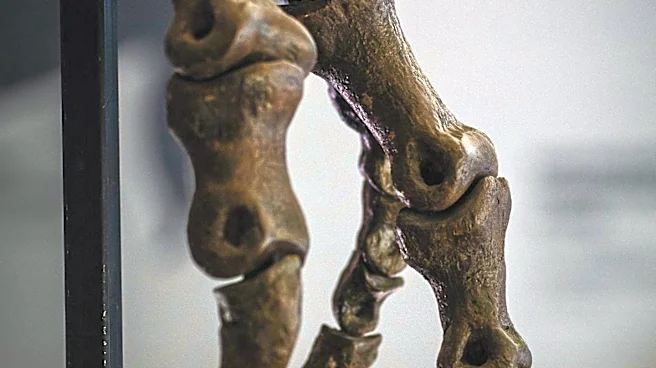
Recent research, detailed in a paper by Dr. Yousuke Kaifu and colleagues, has revealed that Denisovans, an extinct archaic human group, were surprisingly large-bodied. This conclusion is based on the analysis of two fossilized leg bones—a femur and a tibia,
known as Penghu 2 and Penghu 3—recovered decades ago from the Penghu Channel in the Taiwan Strait. These bones, dating back approximately 45,000 to 43,000 years, indicate that some Denisovans could have stood around 180 cm (5 feet 11 inches) to 190 cm (6 feet 3 inches) tall and weighed between 83 kg (183 pounds) and 91 kg (200 pounds). The identification of these bones as Denisovan was confirmed through the analysis of ancient proteins, specifically a genetic variant in a collagen protein unique to Denisovans. This finding challenges the long-held paleoanthropological expectation known as Bergmann’s rule, which suggests that populations closer to the tropics tend to be smaller.
Why It's Important?
This discovery significantly alters our understanding of Denisovan physical characteristics and their adaptation strategies. The unexpectedly large stature of these Denisovans, particularly in a tropical region like Taiwan, suggests that their body architecture might have been influenced by factors beyond climate, such as their diet and hunting methods. The research proposes that a meat-based diet and a specific hunting strategy, possibly relying on different tools than those used by local Homo sapiens, could have necessitated a larger body size. This challenges previous assumptions about human evolution and adaptation in different geographical zones. Furthermore, the presence of a pronounced ridge of bone (pilaster) on the Penghu 2 femur, typically associated with modern humans and a highly mobile lifestyle, hints at either behavioral convergence with early modern humans or potential interbreeding between the two groups, aligning with existing genetic evidence of gene flow between Denisovans and anatomically modern Homo sapiens in Asia.
What's Next?
The research team's paper was posted on the preprint server bioRxiv.org, indicating that it is undergoing peer review. Future steps will likely involve further genomic analysis of Denisovan fossils to test hypotheses regarding the genetic basis of features like the femoral pilaster and to explore the extent of interbreeding with modern humans. Continued archaeological and paleontological excavations in East Asia, particularly in regions where Denisovan remains have been found, could yield more postcranial fossils, providing a more complete picture of their body architecture and lifestyle. Researchers will also likely investigate the specific dietary and environmental pressures that could have led to such a large body size in tropical Denisovan populations, potentially through isotopic analysis of more remains.
Beyond the Headlines
The implications of this discovery extend beyond mere physical dimensions, offering a deeper insight into the complex evolutionary history of archaic humans in Asia. The idea that Denisovans, a sister group to Neanderthals, were not only widespread across eastern Asia but also possessed a robust physique comparable to the tallest modern humans, reshapes our understanding of their ecological niche and competitive advantages. This finding could lead to a re-evaluation of how different Homo species interacted and adapted to diverse environments. The potential for behavioral convergence or interbreeding, suggested by the femoral pilaster, underscores the intricate and often intertwined evolutionary paths of various human lineages, challenging simplistic models of human dispersal and interaction. It highlights the dynamic nature of human evolution, where adaptation to local conditions and genetic exchange played crucial roles in shaping our ancestors.