




What's Happening?
A family-led breeding effort in Northern Virginia has developed ultra-small watermelon lines suitable for vertical farming and high-density production. Led by high school researcher Delaney Raptis, the project aims to address the challenges posed by traditional
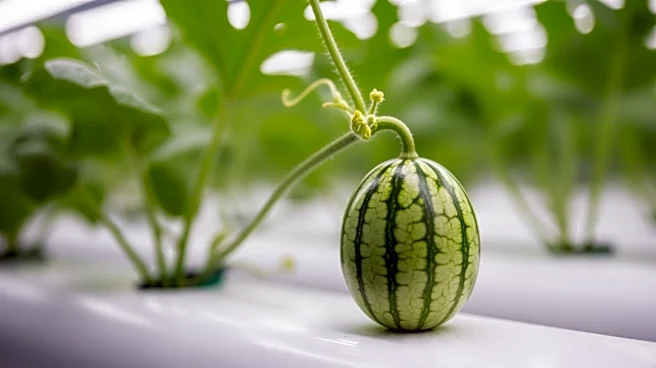
watermelon production in controlled environments, such as extensive vine growth and large fruit size. The new watermelon variety produces fruits ranging from 80 to 200 grams, some as small as a chicken egg, which significantly reduces spatial requirements. Despite the size reduction, the fruits maintain key commercial traits such as sweet flavor, firmness, and durable rind, making them compatible with existing postharvest processes. The breeding program began in 2021 using a non-GMO chemical mutation approach, and the ultra-small fruit trait has shown consistent expression across generations.
Why It's Important?
The development of egg-sized watermelons is significant for the vertical farming industry, which prioritizes space efficiency and crop manageability. Large-fruited cucurbits are generally unsuitable for these environments due to their space requirements. The reduced fruit size of these watermelons may enable higher planting densities and improved system compatibility, making watermelon a more feasible crop within vertical farming models. Additionally, the small fruit size aligns with changing consumption patterns, offering convenience for urban consumers and smaller households, and potentially reducing food waste. The lines may also be suitable for home or urban growers, where limited space often restricts crop selection.
What's Next?
Current efforts are focused on increasing seed stock in preparation for formal trials. Future work will include evaluating performance across different growing systems and engaging with industry stakeholders. Testing these lines under commercial controlled environment agriculture (CEA) conditions will be crucial to determine their practical applications at scale. Collaboration with growers and partners will be important to assess the feasibility of integrating these watermelons into existing production systems.