


What's Happening?
Physicists at CERN in Switzerland, along with researchers from Goethe University Frankfurt, have identified a resonant 'ghost' within the Super Proton Synchrotron (SPS), a key component of CERN's particle accelerator complex. This discovery, published
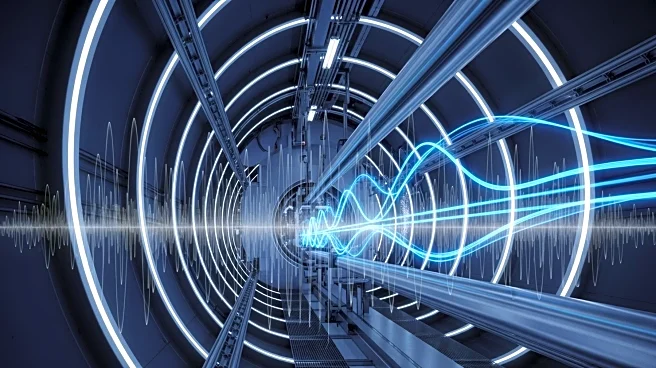
in Nature Physics, reveals how resonance within the SPS can lead to beam degradation, a significant issue for particle acceleration. The SPS, a nearly four-mile-wide ring, has been operational since the 1970s and remains crucial for high-energy physics experiments. The 'ghost' is a result of resonance, where energy waves interact and amplify, causing particles to lose energy. This phenomenon is similar to how waves in a cup of coffee can cause spills. The researchers used mathematical models to map these resonant lines, aiming to mitigate their effects and improve the performance of particle accelerators.
Why It's Important?
The discovery of the resonant 'ghost' is significant for the field of particle physics and the operation of particle accelerators. Understanding and mitigating resonance effects can enhance the efficiency and accuracy of experiments conducted at facilities like CERN. This has implications for future research in nuclear fusion and other areas where precise control of particle beams is essential. By addressing these resonance issues, scientists can prevent energy loss and improve the quality of experimental data, potentially leading to breakthroughs in understanding fundamental physics. Additionally, this research could inform the design of new accelerators, helping to avoid similar issues and reduce costs associated with beam degradation.