



What's Happening?
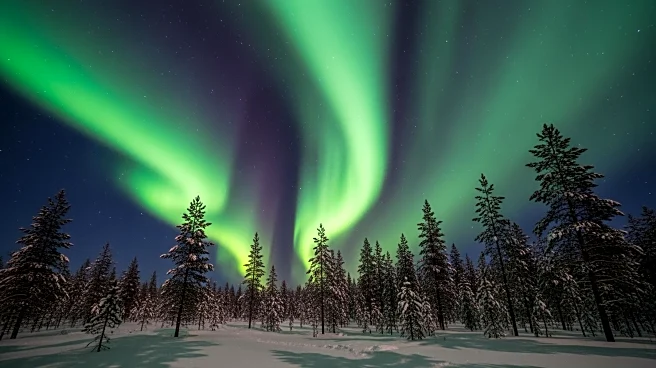
Space weather forecasters are predicting an increase in aurora activity over the Christmas period due to fast solar wind and a potential coronal mass ejection (CME) from the sun. The National Oceanic and Atmospheric Administration (NOAA) and the U.K.
Met Office have reported that a large coronal hole on the sun is emitting unusually fast solar wind, which has already caused minor geomagnetic storms. These conditions are expected to persist through December 24-25, potentially enhancing aurora visibility, particularly in high-latitude regions such as Alaska, northern Canada, and parts of Scandinavia. Additionally, a CME that left the sun on December 20 may pass close to Earth on December 24, possibly increasing aurora activity if it interacts with the solar wind environment around Earth.
Why It's Important?
The potential for increased aurora activity is significant for skywatchers and those interested in space weather phenomena. Auroras, or northern lights, are a natural light display predominantly seen in high-latitude regions, and their increased visibility can attract tourism and interest in these areas. For scientists, such events provide valuable data on solar wind interactions with Earth's magnetosphere, contributing to a better understanding of space weather impacts. Moreover, geomagnetic storms can affect satellite operations, GPS systems, and power grids, making accurate forecasting crucial for mitigating potential disruptions.
What's Next?
As the Christmas period approaches, space weather forecasters will continue to monitor solar activity and provide updates on the likelihood of aurora visibility. Skywatchers in northern U.S. states and other high-latitude regions are advised to stay informed through space weather apps and forecasts to maximize their chances of witnessing the northern lights. Meanwhile, scientists will analyze data from this period to enhance predictive models and improve future space weather forecasts.