



What's Happening?
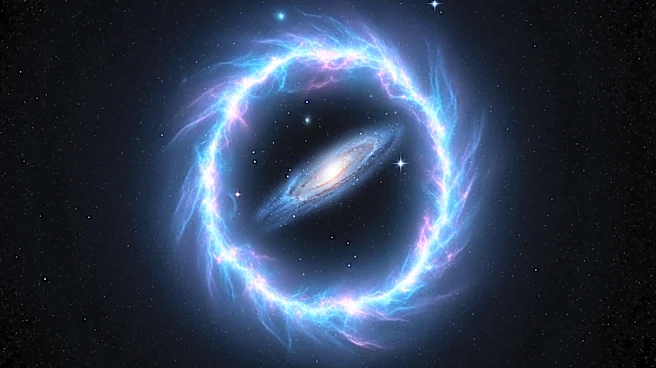
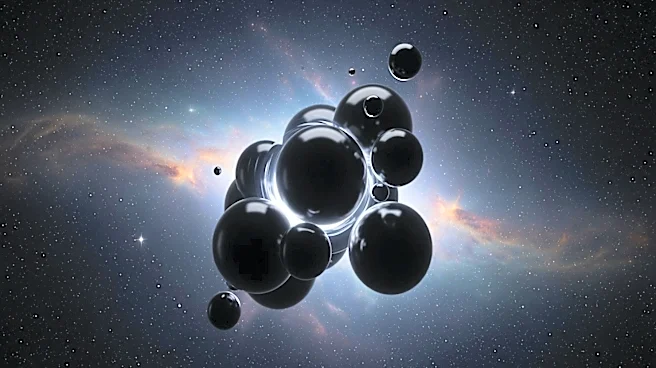
A new theory proposes that dark matter might be composed of relic black holes from a universe that existed before the Big Bang. This hypothesis challenges the traditional view that dark matter consists of undiscovered sub-atomic particles. The theory suggests
that these black holes survived a cosmic 'bounce,' a phase where the universe contracted before expanding again. This idea could explain the presence of massive, luminous objects in the early universe, observed by the James Webb Space Telescope, which are difficult to account for under standard cosmological models.
Why It's Important?
If validated, this theory could revolutionize our understanding of dark matter, one of the most elusive components of the universe. It offers a new perspective on the origins of the universe and the nature of cosmic structures. The concept of a pre-Big Bang universe introduces a paradigm shift in cosmology, potentially explaining phenomena that current models cannot. This could lead to new methods of studying the universe's history and the fundamental forces that shape it, impacting fields ranging from particle physics to astrophysics.