
What's Happening?
Astronomers have identified the source of mysterious, bright blue cosmic flashes known as luminous fast blue optical transients (LFBOTs). These phenomena, which have puzzled scientists for years, are now understood
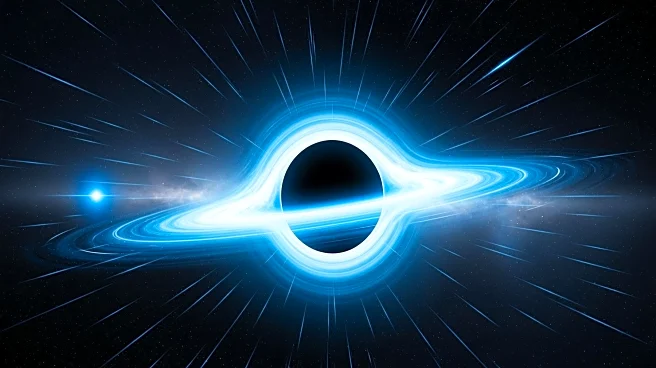
to be caused by the extreme tidal disruption of a massive star by a black hole. The black hole, with a mass up to 100 times that of the sun, completely shreds its stellar companion, resulting in the emission of high-energy light across various wavelengths. This discovery was made possible through the analysis of the brightest LFBOT to date, named AT 2024wpp, which was observed using a range of telescopes including NASA's Chandra X-ray Observatory and the Atacama Large Millimeter/submillimeter Array. The findings resolve a long-standing debate about whether these bursts were due to supernovae or interstellar gas interactions.
Why It's Important?
The identification of LFBOTs as a result of black hole star shredding provides significant insights into the behavior and evolution of intermediate-mass black holes. Understanding these events helps astronomers explore the environments in which large black holes develop and interact with their stellar companions. This knowledge is crucial for advancing theories about black hole formation and growth, which have implications for our understanding of the universe's structure and the lifecycle of stars. Additionally, the study of LFBOTs offers a new perspective on the diverse and complex processes occurring in galaxies, contributing to the broader field of astrophysics.
What's Next?
Future observations and studies of LFBOTs are expected to become more routine with the launch of upcoming ultraviolet telescopes such as ULTRASAT and UVEX. These instruments will enable astronomers to discover and analyze LFBOTs more frequently and in greater detail, allowing for a systematic exploration of their environments and progenitor systems. This increased capability will enhance our understanding of these phenomena and potentially uncover new aspects of black hole and stellar interactions.
Beyond the Headlines
The discovery of the true nature of LFBOTs highlights the importance of multi-wavelength observations in astrophysics. By utilizing a variety of telescopes and instruments, researchers can piece together complex cosmic events that would otherwise remain enigmatic. This approach not only advances our knowledge of specific phenomena like LFBOTs but also strengthens the overall methodology used in the study of the universe.