








What's Happening?
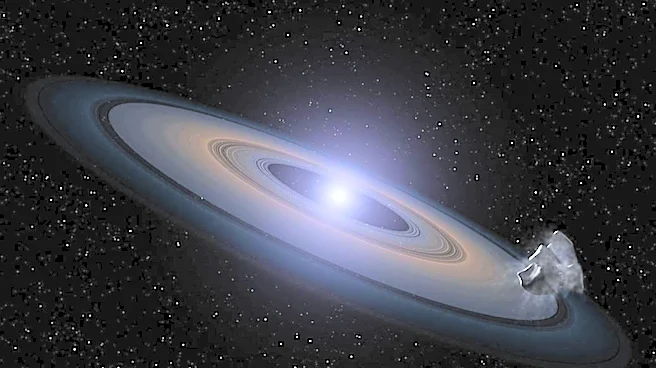
Astronomers have found compelling evidence suggesting the existence of a second-generation planet orbiting the white dwarf star HS 0209+0832, located approximately 270 light-years from Earth in the constellation Cetus. This potential discovery, detailed
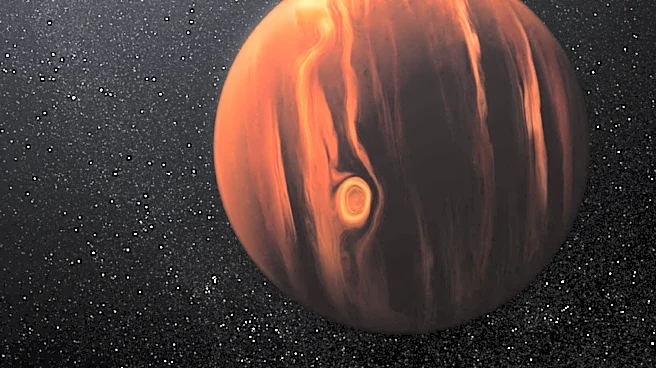
in a study published in Nature Astronomy, indicates that the planet, estimated to be a gas giant similar in size to Jupiter, formed from the remnants of the dying star. Unlike most planets that form alongside their stars, this 'second-generation' planet would have coalesced from material ejected by the star during its red giant phase. Scientists re-analyzed archival data from NASA's Hubble Space Telescope, the FUSE and UVES instruments on ESO’s Very Large Telescope, and data from Pan-STARRS and ESA’s Gaia satellite. The analysis revealed unusual chemical signatures in the white dwarf's atmosphere, including an abundance of elements like niobium, nickel, copper, and zinc, which are typically synthesized under exotic conditions in dying stars. These elements are believed to be accreting onto the white dwarf from the orbiting planet. Additionally, recurring brightness variations with a period of about 4.4 days were detected, which could correspond to temperature differences on a giant planet orbiting very close to the white dwarf.
Why It's Important?
This potential discovery holds significant importance for our understanding of planetary formation and evolution. If confirmed, it would be the first known instance of a second-generation planet, challenging the conventional view that planets primarily form during the birth of their host stars. This finding suggests that planetary systems can be more dynamic and resilient than previously thought, with new worlds potentially forming even after a star's dramatic death. The presence of a planet that could survive the red giant phase and subsequent white dwarf stage expands the possibilities for where life might exist in the universe. University of Warwick astronomer Jamie Williams noted that if the planet survives, it could remain in a stable habitable zone for millions of years as the white dwarf cools, potentially offering a much longer period of habitability than Earth, which will be engulfed by the Sun in about 5 billion years. This research could redefine the 'story' of a star and its planets, indicating that the white dwarf stage is not merely an epilogue but a new chapter where new celestial bodies can emerge.
What's Next?
The discovery of HS 0209+0832b is currently considered a candidate, and further research and verification are needed to officially confirm its existence as a second-generation planet. Astronomers will likely continue to observe the white dwarf and its surroundings using advanced telescopes to gather more definitive evidence. Future observations will aim to confirm the planet's mass, orbital characteristics, and atmospheric composition. The unique chemical signatures observed in the white dwarf's atmosphere provide a roadmap for identifying similar systems, and scientists may begin to search for these specific elemental abundances in other white dwarfs. If confirmed, this discovery will spur new theoretical models and simulations to better understand the processes of planet formation in post-stellar evolution environments. The long-term stability of such a planet in a white dwarf's habitable zone will also be a key area of future study, potentially influencing the search for exoplanets capable of sustaining life.
Beyond the Headlines
The concept of a second-generation planet forming from the remnants of a dying star introduces profound implications for astrobiology and our cosmic perspective. It suggests that the universe might be even more teeming with diverse planetary systems than previously imagined, including those around stellar remnants. This challenges the anthropocentric view of planetary habitability, which often focuses on systems similar to our own. The survival and potential long-term habitability of such a planet around a white dwarf could mean that life, if it arises, might have an extended window to evolve, far beyond the lifespan of a main-sequence star like our Sun. This opens up new avenues for theoretical exploration into the types of life that could adapt to such environments, potentially thriving under the stable, albeit dimmer, light of a cooling white dwarf. The study also highlights the power of re-examining existing astronomical data with new perspectives and advanced analytical techniques, demonstrating that significant discoveries can still emerge from previously collected information.