








What's Happening?
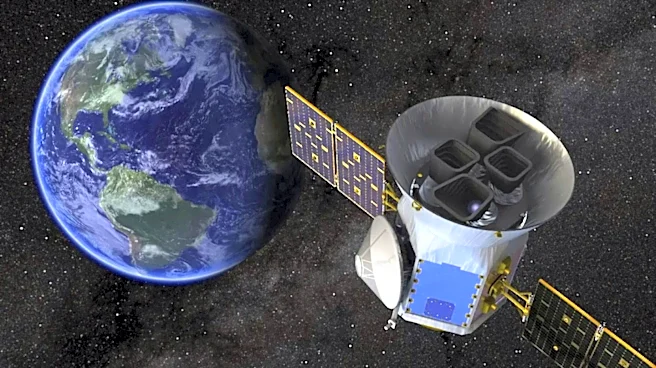
NASA's Transiting Exoplanet Survey Satellite (TESS) has identified two new 'super-puff' planets, TOI-791 b and TOI-791 c, which are notable for their extremely low density, comparable to cotton candy. These planets, orbiting a Sun-like star named TOI-791,
are roughly the size of Jupiter but possess only a fraction of its mass. The discovery was made by observing dips in the star's brightness, indicating planetary transits. The planets have unusually long orbits, with TOI-791 b taking 139 days and TOI-791 c taking 232 days to complete a revolution around their host star. This finding presents a puzzle for scientists, as such low-density planets were not anticipated, prompting further investigation into their formation and evolution.
Why It's Important?
The discovery of these super-puff planets is significant as it challenges existing theories of planetary formation and evolution. Understanding how such low-density planets form could provide insights into the processes that govern the development of planetary systems. The findings may also influence the study of exoplanet atmospheres and compositions, potentially leading to new models of planetary dynamics. This research could have broader implications for our understanding of the universe and the diversity of planetary systems beyond our own.
What's Next?
Further studies are planned to explore the chemical makeup of the planets' atmospheres and their orbital dynamics. Scientists aim to understand how these planets migrated within their system and whether their orbits were influenced by interactions with other celestial bodies. The research could also shed light on the role of large planet formation in the evolution of planetary systems. Continued observation and analysis will be crucial in unraveling the mysteries of these unique celestial bodies.