
What's Happening?
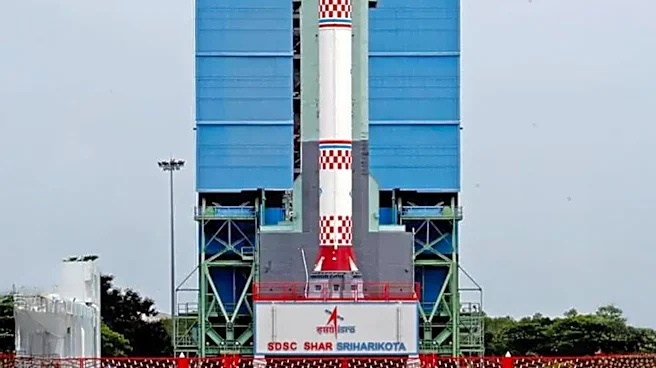
The Indian Space Research Organisation (ISRO) has achieved two significant milestones in its space program. On October 30, 2026, ISRO successfully launched the GSLV-F18/NVS-03 mission, placing the Navigation
Satellite NVS-03 into a precise Geosynchronous Transfer Orbit. This mission marks the 20th flight of India's Geosynchronous Satellite Launch Vehicle and introduces the third satellite in the second generation of NavIC satellites, designed to enhance India's regional navigation system. Concurrently, Aditya-L1, ISRO's pioneering spacecraft dedicated to studying the Sun, has completed one year of continuous observations in space. During this period, Aditya-L1 has gathered critical data concerning the Sun's lower atmosphere and solar flares, contributing valuable insights to solar physics. These achievements underscore ISRO's ongoing advancements in both satellite navigation technology and space-based solar research.
Why It's Important?
The successful deployment of the NVS-03 satellite is crucial for strengthening India's indigenous NavIC navigation system. This system provides accurate real-time positioning and timing services, which are vital for various applications including defense, disaster management, and civilian navigation. Enhanced accuracy and reliability of NavIC reduce India's reliance on foreign navigation systems, bolstering national security and technological sovereignty. The completion of one year of observations by Aditya-L1 is equally significant. Data collected by this solar observatory will help scientists better understand solar phenomena such as solar flares and coronal mass ejections, which can impact Earth's technological infrastructure, including communication systems and power grids. Improved solar weather forecasting capabilities derived from Aditya-L1's data can help mitigate potential disruptions, protecting critical U.S. and global assets.
What's Next?
Following the successful launch of NVS-03, ISRO will continue to integrate the new satellite into the operational NavIC constellation, further enhancing its coverage and precision. Future plans likely include the launch of additional second-generation NavIC satellites to ensure the system's robustness and longevity. For Aditya-L1, the mission will proceed with its ongoing data collection and transmission. Scientists will continue to analyze the extensive data gathered over the past year, with anticipated publications of new findings and insights into solar dynamics. This ongoing research is expected to contribute to a more comprehensive understanding of the Sun's influence on space weather and its broader implications for Earth. ISRO's continued advancements in space technology are likely to foster further international collaborations in space exploration and satellite applications.
Beyond the Headlines
These developments highlight India's growing prowess in space technology, positioning it as a significant player in the global space arena. The NavIC system's expansion reflects a broader trend among nations to develop independent satellite navigation capabilities, driven by strategic and economic considerations. This pursuit of self-reliance in critical space infrastructure could influence international norms and cooperation in space, potentially leading to new partnerships or increased competition. Furthermore, Aditya-L1's sustained success in solar observation contributes to the global scientific community's collective effort to unravel the mysteries of our star. The data could lead to breakthroughs in fundamental physics and improve our ability to predict and prepare for space weather events, which have increasingly tangible impacts on modern technological societies worldwide.