









What's Happening?
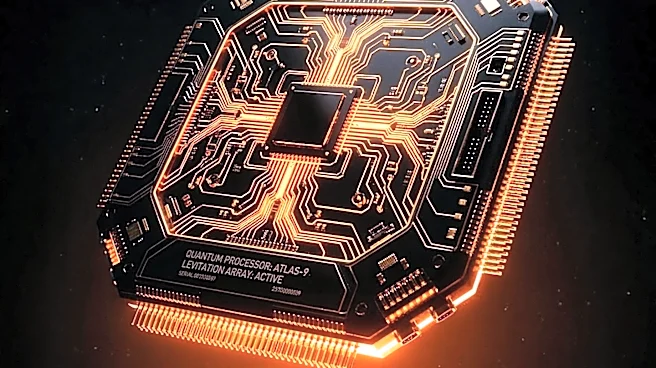
Oak Ridge National Laboratory (ORNL), IBM, and AMD have jointly launched a co-design platform for quantum error correction (QEC) at IBM's Poughkeepsie, New York site. This platform aims to accelerate classical and quantum workflows for scientifically
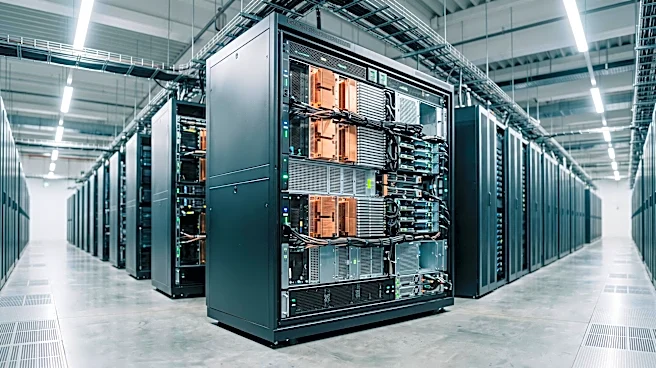
relevant quantum computing. The initiative pairs IBM Quantum Nighthawk processors with ORNL’s Umbra, a high-performance computing (HPC) system featuring AMD Instinct MI355X GPUs and 5th Gen AMD EPYC™ CPUs. This co-located environment is also linked to ORNL's broader supercomputing ecosystem. The platform allows researchers to develop and validate quantum algorithms and workflows in a hybrid HPC-quantum computing setting, addressing the challenge of integrating quantum and classical computing resources that are typically separate.
Why It's Important?
Quantum error correction is crucial for the development of practical quantum computers, as qubits are highly susceptible to errors. The co-design platform provides a dedicated environment for researchers to test and refine error correction methods, which are computationally intensive and require significant classical computing power. By co-locating quantum processors and high-performance classical computing, the platform achieves low-latency quantum-classical execution, essential for real-time decoding and conditional execution in quantum algorithms. This integration is vital for advancing the U.S. Department of Energy’s Genesis Mission, which targets the deployment of a scientifically relevant quantum computer by 2028, and for IBM's goal of delivering the fault-tolerant IBM Quantum Starling by 2029. The platform's ability to handle infrastructure allows researchers to focus on algorithm discovery, potentially accelerating breakthroughs in quantum computing.
What's Next?
The co-design platform will enable researchers to explore hierarchical error correction, a promising approach that layers two codes to protect qubits. This method relies heavily on powerful classical computing for decoding at each layer, and the platform provides the necessary low-latency environment for testing these ideas with GPUs. The insights gained from this research will inform the architecture, software, and workflows for future quantum systems, including IBM Quantum Starling. The collaboration will also investigate how future generations of AMD compute, networking, and open software can be co-designed with quantum computers. This ongoing research is expected to contribute significantly to achieving the Genesis Mission's target of 100 logical qubits running 100,000 operations by late 2028.
Beyond the Headlines
This collaboration represents a significant step towards quantum-centric supercomputing, where quantum processors, CPUs, and GPUs work together as a single system. The integration of these diverse computing elements in a low-latency environment addresses a fundamental challenge in quantum research: bridging the gap between theoretical quantum algorithms and their practical implementation. By providing a shared environment, the platform democratizes access to advanced quantum and classical computing resources, allowing a broader range of researchers to contribute to the field. This could lead to unforeseen applications and accelerate the development of quantum technologies beyond current expectations, impacting fields from materials science to drug discovery and complex system optimization.