





What's Happening?
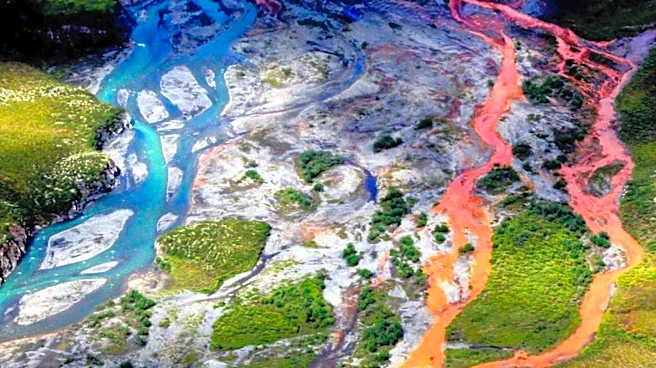
A recent exploration into the mathematical nature of river networks has reignited interest in their universal form. The study of river networks, which dates back to the late 1800s, has been a significant area of research for geomorphologists. These scientists
focus on the shape and reshaping of Earth's surface, examining how river networks resemble fractals—mathematical objects with repeating patterns at various scales. A key discovery in this field was made in 1957 by U.S. Geological Survey scientist John Hack, who formulated Hack's law. This law states that the length of a stream is proportional to its drainage area raised to the power of 0.6. Despite the complexity of Earth's geology, this relationship holds remarkably consistent across different terrains.
Why It's Important?
Understanding the mathematical principles governing river networks is crucial for several reasons. It provides insights into natural processes that shape the Earth's surface, which can inform environmental management and conservation efforts. The predictability of river patterns can aid in flood management, water resource planning, and ecological studies. Moreover, the study of these natural fractals can enhance our understanding of other branching systems, such as blood vessels and plant roots, potentially leading to advancements in fields like medicine and agriculture. The research underscores the interconnectedness of natural systems and the importance of mathematical models in explaining complex phenomena.