



What's Happening?
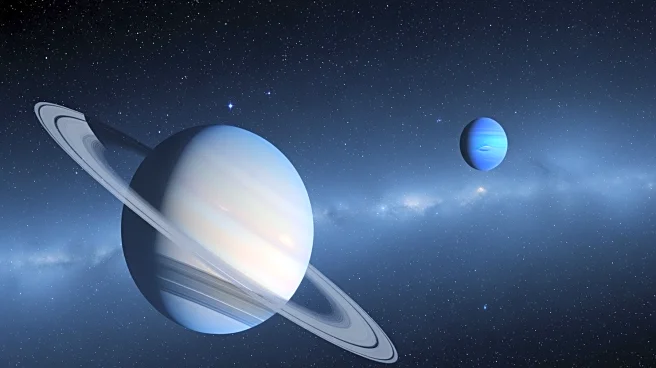
Astronomy Magazine provides guidance for stargazers to locate Neptune in the night sky using Saturn as a reference point. Throughout January, Saturn and Neptune are positioned close together, with Saturn serving as a bright marker to find the more distant
Neptune. Observers are advised to use optical aids to view Neptune, which appears as a small, bluish disk with a magnitude of 7.8. Saturn, with its prominent rings and moon Titan, is easier to spot at magnitude 1.0. The article details the optimal viewing times and positions for these planets, emphasizing the early evening as the best period before they set by midnight.
Why It's Important?
This celestial event offers a unique opportunity for amateur astronomers and enthusiasts to observe two of the solar system's distant planets in close proximity. The guidance provided by Astronomy Magazine helps enhance public interest in astronomy and encourages educational engagement with the night sky. Observing such planetary alignments can foster a greater appreciation for space science and inspire future explorations. Additionally, the event serves as a practical application of astronomical knowledge, allowing individuals to apply observational techniques and improve their skills in identifying celestial bodies.
What's Next?
As January progresses, Saturn will move closer to Neptune, reducing their angular separation from 3.5° to 1.7° by the end of the month. This gradual change in position will provide ongoing opportunities for observation and study. Stargazers are encouraged to continue monitoring the planets' movements and take advantage of clear skies to capture images or make detailed observations. The event may also prompt discussions and activities within astronomy clubs and educational institutions, further promoting interest in planetary science.