
What's Happening?
Dark energy, an unknown phenomenon associated with the universe’s accelerating expansion, continues to be one of astronomy’s greatest unanswered questions. While it cannot be observed directly, its effects
are evident through measurements of distant galaxies, exploding stars, and the large-scale structure of the cosmos. Current cosmological models suggest that dark energy constitutes approximately 68% of the universe, making it the dominant component. One leading explanation posits that dark energy may be an inherent property of space itself, represented mathematically by the cosmological constant in Albert Einstein’s equations of general relativity. However, scientists have not definitively confirmed this explanation, exploring other possibilities such as changing forms of energy (quintessence) or potential modifications to the understanding of gravity on cosmic scales. The universe has been expanding since the Big Bang, and observations from the late 1990s revealed that this expansion is not merely continuing but accelerating.
Why It's Important?
Understanding dark energy is critical for comprehending the ultimate fate and evolution of the universe. Its dominance in the cosmos means that its nature dictates how the universe will continue to expand, whether it will eventually slow down, continue accelerating indefinitely, or even reverse. This knowledge has profound implications for fundamental physics, potentially requiring revisions to current theories of gravity and particle physics. The ongoing research into dark energy impacts the U.S. scientific community by driving significant investments in space telescopes and ground-based observatories, fostering international collaborations, and inspiring new generations of scientists. The pursuit of answers to this cosmic mystery pushes the boundaries of technological innovation and theoretical modeling, contributing to advancements in data analysis, artificial intelligence, and observational techniques that have broader applications beyond astrophysics.
What's Next?
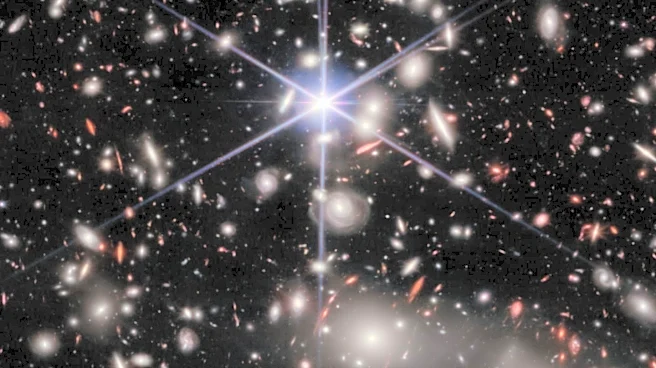
Scientists will continue to investigate dark energy by studying the universe on its largest scales. This involves measuring distances to distant supernovae, mapping galaxies across space, and examining how gravity bends light from faraway objects. Missions like NASA’s Nancy Grace Roman Space Telescope are specifically designed to support this research by surveying large areas of the sky, studying distant supernovae, and mapping galaxy distribution. These observations will help determine if dark energy remains constant or changes over time. If dark energy is found to change, it could necessitate a significant rethinking of current cosmological models. Future observations and experiments aim to narrow down the possibilities and provide a clearer picture of dark energy's nature and its role in the universe's future.
Beyond the Headlines
The enigma of dark energy transcends purely scientific inquiry, touching upon philosophical questions about the nature of reality and the limits of human understanding. The fact that the majority of the universe is composed of something invisible and poorly understood challenges our intuitive grasp of the cosmos. This ongoing mystery highlights the humility required in scientific exploration, reminding us that even with advanced technology, fundamental aspects of the universe remain elusive. The pursuit of dark energy research also fosters a global scientific culture of collaboration and shared inquiry, as no single nation or institution can tackle such a monumental question alone. The long-term implications could involve a complete re-evaluation of our cosmic address and the fundamental laws governing existence, potentially leading to new paradigms in physics and a deeper appreciation for the universe's complexity.