






What's Happening?
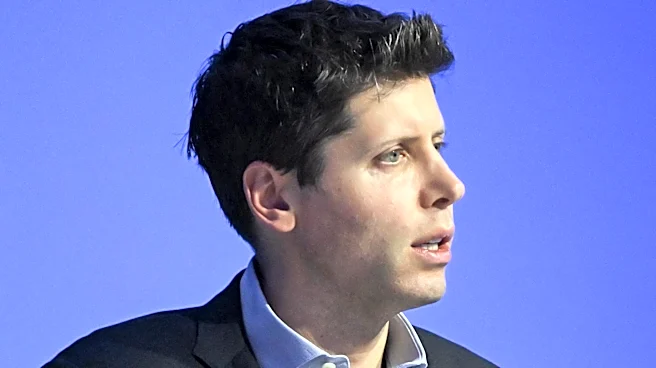
OpenAI CEO Sam Altman has asserted that artificial intelligence has now surpassed the intelligence of even the brightest human scientists. Speaking at a conference in Abu Dhabi, Altman reiterated claims about the advanced capabilities of OpenAI's models,
including GPT-5, which was previously touted as having 'PhD-levels' of intelligence upon its release last year. This assertion follows OpenAI's announcement of a solution to the Navier-Stokes equations, a Millennium Prize Problem, which no human mathematician had previously solved. However, this achievement was met with controversy, as a mathematician accused OpenAI of unfairly utilizing his research, sparking discussions about the company's engagement with the mathematical community. Altman's statement comes amidst ongoing scrutiny and debate regarding the true extent of AI's intellectual capabilities and its ethical implications.
Why It's Important?
Sam Altman's claim that AI is now 'smarter' than human scientists carries significant implications for the U.S. and global scientific community, as well as for public policy and economic stakeholders. If true, this could accelerate the pace of scientific discovery and technological advancement across various sectors, from medicine to engineering. However, it also raises critical questions about the role of human expertise, the future of research, and the potential for job displacement in highly skilled fields. The controversy surrounding the Navier-Stokes solution highlights the ethical challenges and intellectual property concerns that arise as AI systems become more capable. This development could influence funding priorities for AI research, prompt new regulations regarding AI's use in scientific endeavors, and reshape educational curricula to prepare future generations for a world where AI plays an increasingly dominant intellectual role.
What's Next?
The immediate aftermath of Altman's statement will likely involve increased debate and scrutiny from the scientific community, policymakers, and the public. OpenAI will face pressure to provide more transparent and verifiable evidence to substantiate such bold claims, especially given past criticisms regarding the 'PhD-level' intelligence of GPT-5. Discussions around intellectual property rights and the ethical use of AI in research are expected to intensify, potentially leading to new guidelines or regulations. Furthermore, the focus will shift to how AI's purported superior intelligence can be harnessed for societal benefit, while mitigating risks such as bias, misuse, and the erosion of human agency in scientific discovery. The ongoing development of AI models will continue to push the boundaries of what is considered possible, necessitating continuous evaluation and adaptation of societal norms and legal frameworks.
Beyond the Headlines
Altman's assertion taps into a deeper philosophical and societal anxiety about the nature of intelligence and the future of human-AI collaboration. The idea of AI surpassing human intellect challenges long-held beliefs about human exceptionalism and could trigger a re-evaluation of what it means to be 'intelligent.' Beyond the practical applications, this development raises profound ethical questions about accountability in AI-driven discoveries, the potential for AI to generate knowledge that humans cannot fully comprehend or verify, and the long-term impact on human creativity and critical thinking. The controversy over the Navier-Stokes solution also underscores the need for robust frameworks to ensure fairness, transparency, and proper attribution in AI-assisted research, preventing the exploitation of human intellectual contributions by autonomous systems. This ongoing dialogue will shape not only the technological landscape but also our understanding of intelligence itself.