



What's Happening?
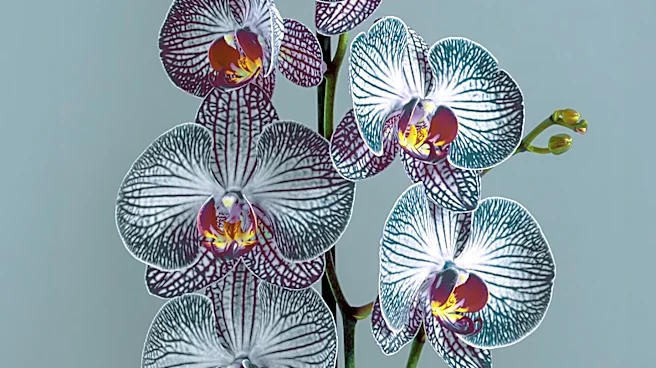
Charles Darwin's home, Down House, offers a glimpse into his life and scientific pursuits, particularly his deep fascination with orchids. Despite his monumental work on 'On the Origin of Species,' Darwin dedicated significant time to studying orchids,
meticulously examining specimens from around the world. He was able to deduce from their structure how they were pollinated, even predicting the existence of a moth with a specific tongue length based solely on an orchid's flower tube, a prediction later confirmed. His work on orchids, published in 1862, served to answer criticisms leveled against his theory of natural selection. The gardens at Down House, maintained by his wife Emma, also reflect his interests, with plants he would have studied. The narrative highlights how Darwin's scientific journey was intertwined with his personal life and the environment he cultivated.
Why It's Important?
Darwin's extensive study of orchids is important because it provided crucial empirical evidence supporting his theory of natural selection, demonstrating the intricate adaptations of species to their environments. His ability to predict the existence of an unknown pollinator based on floral structure showcased the power of his evolutionary insights. This work not only solidified his scientific arguments but also revealed the depth of his observational skills and dedication to detailed biological study. The story also underscores the collaborative and iterative nature of scientific discovery, as Darwin built upon the work of others, like his grandfather Erasmus, and his own findings were later expanded upon by scientists like Noëll Bernard and Jane Loudon. It illustrates how seemingly niche scientific interests can contribute significantly to foundational theories that reshape our understanding of life.
What's Next?
The ongoing study of orchids continues to reveal new insights into plant biology and evolution, building upon Darwin's foundational work. Modern botanists, for instance, are exploring the complex symbiotic relationships between orchids and fungi, a phenomenon Darwin was aware of but whose full implications were not understood in his time. Recent experiments, such as those at the University of Sheffield, have demonstrated how parent orchids can send nutrients to their offspring via underground fungal networks, a concept termed 'parental nurture.' These discoveries continue to deepen our understanding of ecological interactions and the intricate mechanisms of survival and reproduction in the plant kingdom. The legacy of Darwin's orchid research continues to inspire new avenues of scientific inquiry, pushing the boundaries of what we know about the natural world.
Beyond the Headlines
Darwin's orchid obsession reveals a deeper aspect of scientific inquiry: the pursuit of knowledge driven by passion and meticulous observation. His willingness to delve into the minute details of orchid anatomy, even amidst the broader implications of his theory of evolution, exemplifies the scientific method at its best. The narrative also touches on the historical context of scientific thought, contrasting Darwin's groundbreaking ideas with earlier, less accurate theories, such as his grandfather's. Furthermore, the story highlights the often-overlooked contributions of individuals like Jane Loudon, who challenged prevailing scientific misconceptions and paved the way for a more accurate understanding of plant biology. This historical perspective underscores the continuous evolution of scientific understanding and the importance of challenging established norms to uncover new truths about the natural world.