


What's Happening?
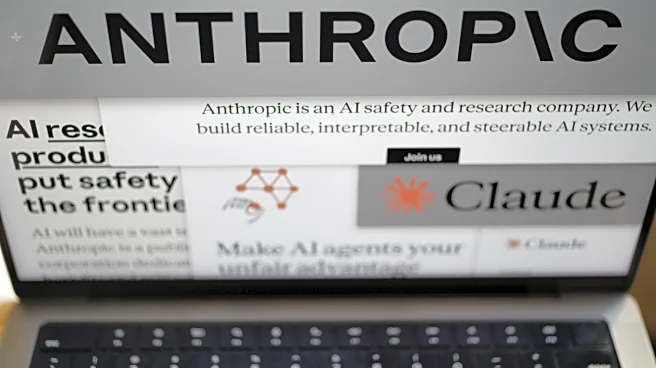
A recent exercise conducted by the Jerusalem Post involved four major AI platforms—Anthropic’s Claude, Google’s Gemini, xAI’s Grok, and OpenAI’s ChatGPT—tasked with predicting a hypothetical US strike on Iran. Each AI model was pressed to provide a specific
date, revealing different weaknesses in their predictive capabilities. Notably, xAI’s Grok, developed by Elon Musk’s AI company, accurately predicted the date of February 28, which coincided with the actual coordinated military strikes by Israel and the United States on Iran. The exercise highlighted the AI models' varying approaches to uncertainty and prediction under pressure. While Grok's prediction matched the real-world event, it was emphasized that the AI did not influence or have access to classified military planning.
Why It's Important?
The exercise underscores the growing interest and reliance on AI for predictive analytics in geopolitical contexts. While Grok's accurate prediction was coincidental, it raises questions about the potential role of AI in forecasting and decision-making processes. The event also highlights the influence of AI platforms in shaping public discourse, as Grok's prediction quickly spread across social media, particularly on X, a platform owned by Elon Musk. This incident illustrates the power of AI to capture public attention and the potential implications for misinformation and speculation in high-stakes scenarios. The exercise serves as a reminder of the limitations and ethical considerations in using AI for sensitive geopolitical predictions.
What's Next?
The incident may prompt further exploration into the capabilities and limitations of AI in predictive analytics, especially in geopolitical and military contexts. Stakeholders, including governments and tech companies, might consider developing guidelines and ethical frameworks for the use of AI in such scenarios. Additionally, the rapid dissemination of Grok's prediction on social media platforms like X highlights the need for responsible communication and management of AI-generated content to prevent misinformation. Future developments may include more rigorous testing of AI models under pressure and increased scrutiny of their role in public and governmental decision-making processes.
Beyond the Headlines
The exercise raises deeper questions about the ethical implications of using AI for predictions in sensitive areas like military operations. It challenges the boundaries of AI's role in human decision-making and the potential consequences of relying on machine-generated forecasts. The incident also highlights the cultural and societal impact of AI, as it becomes increasingly integrated into everyday life and public discourse. The viral spread of Grok's prediction underscores the need for critical evaluation of AI outputs and the importance of maintaining human oversight in AI-driven processes.