
What's Happening?
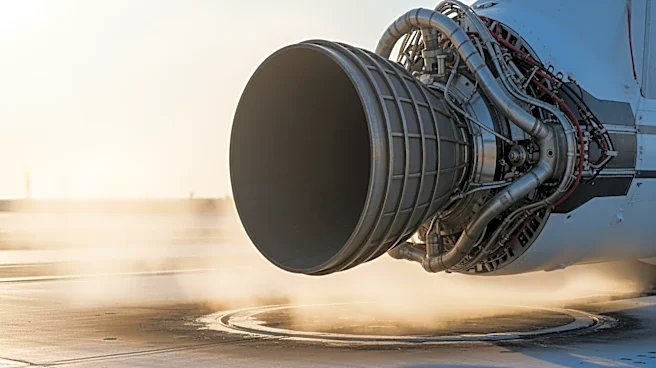
SpaceX has successfully conducted a static-fire test of its Starship 'V3' Super Heavy rocket booster at its Starbase site in Texas. This test involved igniting all 33 Raptor engines of the booster while
it remained anchored to the pad, marking the first successful full-up static fire test for this version. The test is a critical step towards the planned test flight of the Starship, which is targeted for May 15. This will be the 12th test flight for Starship and the first for the new, more powerful 'Version 3' of the vehicle. The Starship program is part of SpaceX's broader goal to facilitate human settlement on the Moon and Mars.
Why It's Important?
The successful static fire test is a significant milestone for SpaceX as it advances its Starship program, which is central to the company's long-term vision of space exploration and colonization. The Starship is the largest and most powerful rocket ever built, capable of carrying over 100 tons of payload to low Earth orbit. Its development is crucial for NASA's Artemis program, which aims to return humans to the Moon. The success of this test brings SpaceX closer to achieving its goal of providing a reliable and reusable spacecraft for deep space missions, potentially revolutionizing space travel and exploration.
What's Next?
Following the successful static fire test, SpaceX plans to conduct the 12th test flight of the Starship on May 15. This flight will be suborbital, and further tests will be required before the Starship can participate in NASA's Artemis missions. Future steps include outfitting the Starship with a life-support system and demonstrating its ability to reach orbit and be refueled in space. These developments are crucial for the Starship to fulfill its role in NASA's lunar exploration plans and for SpaceX's ambitions of interplanetary travel.