



What's Happening?
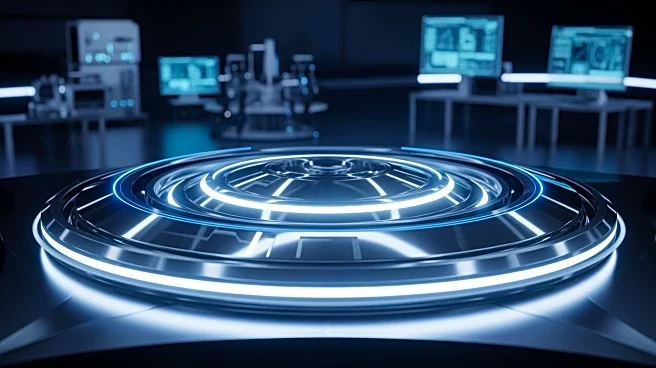
China has introduced the CHIEF1900, the world's most powerful hypergravity centrifuge, developed by the Chinese Academy of Sciences. This machine surpasses the previous record-holder, the CHIEF1300, also from China. The CHIEF1900 is designed to simulate
extreme environments for scientific and industrial testing, offering new possibilities for exploring physical phenomena and advancing space technologies. Operated by the Institute of Physical and Chemical Research, the centrifuge can generate a combined force of 1900 g-tonnes using a 12-meter-long rotating arm. This allows researchers to compress the effects of time and gravity into short-duration experiments, facilitating tests in material science, planetary geology, and biomedicine. The machine's ability to recreate conditions like those deep inside planets or under extreme stress is significant for scientific research.
Why It's Important?
The development of the CHIEF1900 represents a significant advancement in China's infrastructure for space simulation, providing a substantial edge in replicating harsh planetary environments without leaving Earth. This centrifuge allows for real-time monitoring and testing of materials and structures meant for extreme environments, such as space, in a controlled lab setting. By enabling the compression of natural processes that would typically take years into days or hours, the CHIEF1900 opens up new possibilities for scientific research and technological development. This capability reduces the need for costly space missions or massive outdoor setups, saving time and resources while providing more accurate and repeatable results.
What's Next?
The CHIEF1900 is expected to be used for experiments in rock mechanics, fluid migration, and multi-phase flow, which are typically studied in underground labs or through expensive field campaigns. By bringing these tests into a lab setting, scientists can eliminate many unpredictable factors associated with fieldwork, leading to more precise outcomes. The centrifuge's development is also seen as a strategic move to enhance China's ability to conduct advanced experiments independently, without relying on external resources. This could lead to further advancements in space technology and materials science, positioning China as a leader in these fields.
Beyond the Headlines
The CHIEF1900's ability to simulate extreme environments has broader implications for various industries, including aerospace, construction, and materials science. By providing a platform for testing under high g-forces, the centrifuge could lead to innovations in designing structures and materials capable of withstanding harsh conditions. This development also highlights China's growing investment in scientific research and technology, potentially influencing global dynamics in space exploration and industrial testing. The centrifuge's capabilities may inspire similar advancements in other countries, fostering international collaboration or competition in space technology and research.