




What's Happening?
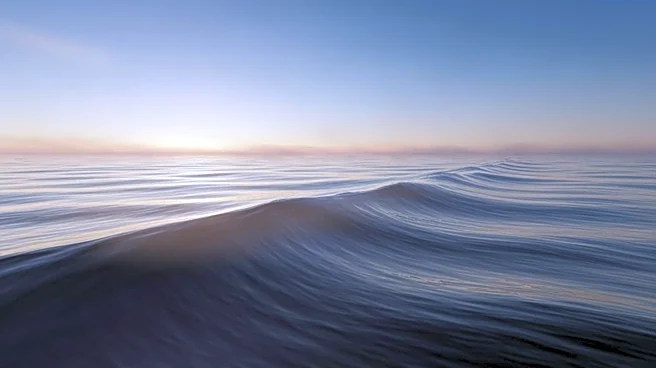
Researchers from MIT and the Woods Hole Oceanographic Institution have developed a new model that simulates wave formation and behavior on alien oceans, such as those on Saturn's moon Titan. This model considers variations in gravity, liquid composition,
and atmospheric density, which are crucial factors that influence wave dynamics. The study, published in the Journal of Geophysical Research: Planets, reveals that waves on extraterrestrial bodies could behave in ways that challenge our Earth-based understanding. For instance, Titan's seas, composed of liquid hydrocarbons, may feature waves that are larger and slower due to the moon's lower gravity and thicker atmosphere. This research provides a framework for understanding how waves might form on planets with different environmental conditions, offering insights into the geological and climatic processes of these distant worlds.
Why It's Important?
The development of this model is significant for future space exploration and mission planning. Understanding wave dynamics on alien oceans is crucial for designing probes and instruments that can withstand the forces exerted by these waves. This knowledge is particularly relevant for proposed missions to Titan, where landers or floating platforms could interact with its liquid surfaces. Additionally, the model helps address geological puzzles, such as the absence of deltas on Titan's coastlines, by simulating how waves might redistribute sediments. This research not only enhances our understanding of extraterrestrial environments but also aids in the preparation for future exploratory missions, potentially leading to groundbreaking discoveries about the solar system's diverse planetary landscapes.
What's Next?
The insights gained from this model could influence the design and engineering of future space missions targeting bodies with liquid surfaces, such as Titan. Engineers will need to consider the unique wave dynamics when developing landers or floating instruments to ensure they can withstand the environmental conditions. Furthermore, the model may guide future observational missions aimed at directly studying these alien seas, providing a clearer picture of their behavior and characteristics. As space agencies plan missions to explore these distant worlds, the model will serve as a critical tool in predicting and understanding the challenges and opportunities presented by extraterrestrial oceans.