
What's Happening?
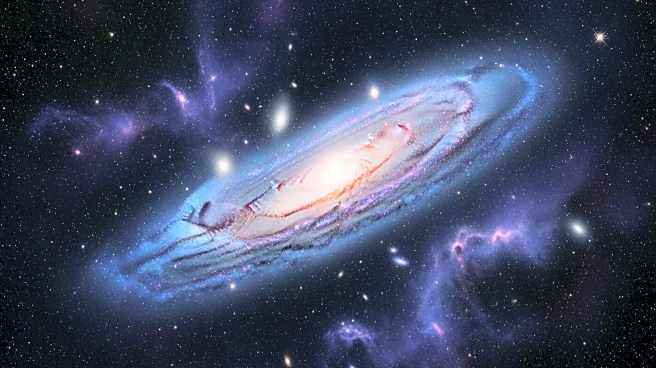
Astronomers have discovered a grand-design spiral galaxy named Alaknanda, which formed approximately 1.5 billion years after the Big Bang. This discovery challenges existing astrophysical models regarding
the timescale required for galaxies to achieve such structural maturity. The James Webb Space Telescope (JWST) and gravitational lensing by the galaxy cluster Abell 2744 were used to observe Alaknanda's detailed spiral structure. The galaxy exhibits two sweeping spiral arms, a bright central region 30,000 light-years across, and a star formation rate 20 times faster than the Milky Way. This finding suggests that processes like gas accretion and the development of spiral density waves may operate more efficiently in the early universe than previously thought.
Why It's Important?
The discovery of Alaknanda necessitates a re-evaluation of current theoretical frameworks for galaxy formation. It indicates that the early universe was capable of more rapid galaxy assembly than anticipated, compelling astronomers to rethink how galaxies form. The ability of Alaknanda to organize into a grand-design spiral in such a short cosmic timeframe suggests that the physical processes driving galaxy formation can operate far more efficiently than current models predict. This has significant implications for our understanding of the universe's evolution and the mechanisms behind galaxy formation.
What's Next?
Future observations with the James Webb Space Telescope could provide more insights into how Alaknanda's spiral arms formed so quickly. Researchers aim to measure the galaxy's rotation speed and disk movement to determine whether its structure is orderly or turbulent. This data could support theories about the galaxy's formation, such as the influence of cold gas streams or gravitational encounters with smaller galaxies. These observations will help refine models of galaxy formation and improve our understanding of the early universe.
Beyond the Headlines
The discovery of Alaknanda highlights the potential for unexpected findings in the early universe, challenging long-held assumptions about galaxy formation. It underscores the importance of advanced telescopes like the JWST in expanding our knowledge of cosmic history. The ability to observe such distant and ancient galaxies provides a unique opportunity to study the conditions and processes that shaped the universe's evolution, offering new perspectives on the fundamental forces at play in galaxy formation.