




What's Happening?
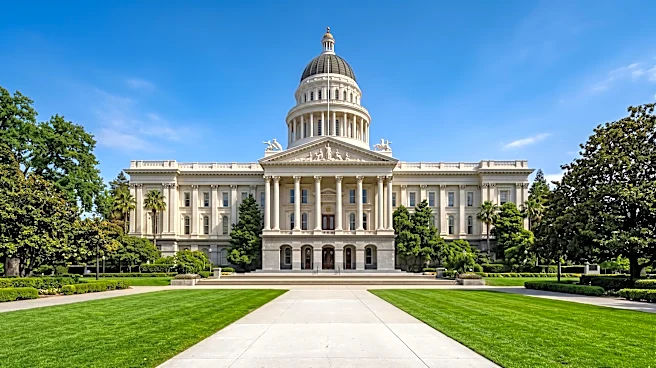
California Governor Gavin Newsom has signed Senate Bill 1406 into law, effectively closing a tax loophole that allowed luxury car owners to avoid California sales taxes by registering their vehicles through shell companies in Montana. This strategy exploited
Montana's lack of a statewide sales tax on vehicle purchases and its permissive LLC formation rules. The new law expands California's criteria for determining when a shell company is considered a California resident for tax purposes. If any shareholder, partner, member, or beneficial owner of a shell company is a California resident, the company can now be treated as such. Officers and members can also be held personally liable for unpaid taxes, interest, and penalties, with failure to pay potentially constituting a crime. California officials estimate the state could recover $20 million annually by closing this loophole.
Why It's Important?
This legislative action is significant for California's state revenue and tax fairness. The estimated $20 million in recovered annual tax revenue can be directed towards essential state services, such as road repairs, as highlighted by State Senator Jerry McNerney. More broadly, closing this loophole addresses a perceived inequity where wealthy individuals could circumvent tax obligations, while average citizens pay their share. This move reinforces the principle that tax laws should apply equitably to all residents, regardless of their financial status or ability to exploit legal technicalities. It also sends a strong message to those attempting similar tax avoidance schemes, potentially deterring future attempts and strengthening the integrity of the state's tax system.
What's Next?
With the new law in effect, California will likely begin enforcing the expanded criteria for residency and pursuing individuals and companies that have used the 'Montana loophole.' This could lead to investigations, assessments of back taxes, and potential legal actions against those found to be in violation. Luxury car owners who previously used this strategy will need to re-evaluate their vehicle registrations and tax compliance to avoid penalties. The state may also launch public awareness campaigns to inform residents about the changes and the consequences of non-compliance. The success of this measure in recovering the projected $20 million will be closely watched, and it could inspire other states facing similar tax avoidance issues to adopt comparable legislation.
Beyond the Headlines
Beyond the immediate financial and legal implications, this development touches on deeper ethical and societal issues related to tax avoidance by the wealthy. The 'Montana loophole' became a symbol of how legal structures can be exploited to create an uneven playing field, fostering resentment among those who cannot afford such schemes. The closure of this loophole reflects a broader trend of states and federal authorities scrutinizing complex financial arrangements designed to minimize tax liabilities. It also highlights the ongoing challenge for governments to adapt tax laws to evolving financial practices and corporate structures, ensuring that the spirit of the law is upheld alongside its letter. This action could contribute to a public discourse about wealth inequality and the responsibility of all citizens to contribute to public services.