


What's Happening?
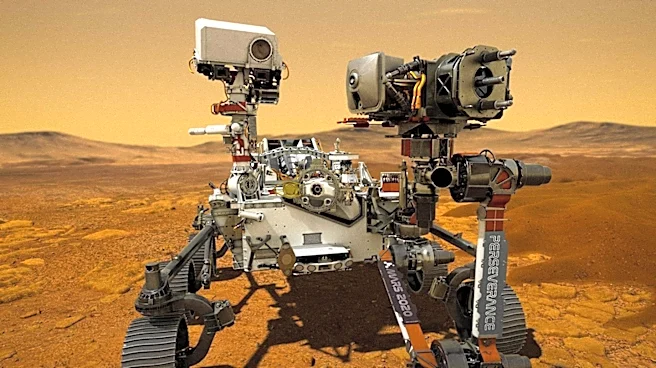
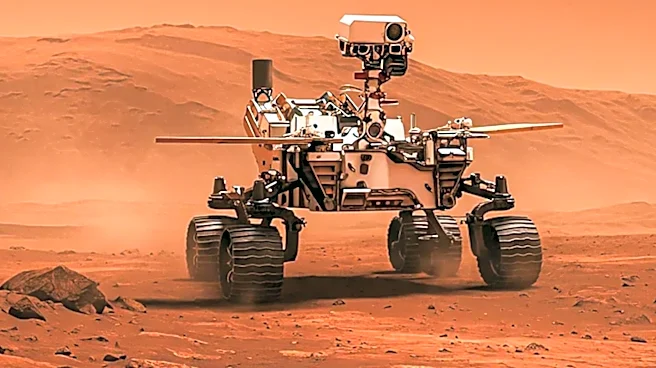
NASA's Perseverance rover, currently exploring Mars, has captured a series of images showing Earth as a small bright dot moving behind the Martian moon Phobos. These images were taken on July 2, 2026, marking the 1,907th Martian day of the mission. The images were captured using
the Mastcam-Z instrument aboard the rover, which is managed by NASA's Jet Propulsion Laboratory in Southern California. The images highlight the movement of Earth from the upper left to the lower right, passing behind Phobos. The background of the images was processed to remove extraneous light, enhancing the visibility of the celestial event. The Perseverance rover, part of NASA's Mars Exploration Program, continues to provide valuable data and insights into the Martian environment.
Why It's Important?
The images captured by Perseverance offer a unique perspective on the relationship between Earth and Mars, providing scientists with valuable data on the Martian atmosphere and its moons. This event also underscores the capabilities of the Perseverance rover in conducting complex observations and experiments on Mars. The data collected can help improve our understanding of Mars' natural satellites and their interactions with the planet. Such observations are crucial for future missions, including potential human exploration of Mars, as they provide insights into the Martian environment and its potential challenges.
What's Next?
As Perseverance continues its mission on Mars, it will likely capture more such celestial events, contributing to our understanding of the Martian system. The rover's ongoing experiments and observations will provide further data on Mars' geology and climate, aiding in the preparation for future manned missions. NASA's continued exploration of Mars, including the study of its moons, will play a critical role in planning for human exploration and potential colonization efforts.