



What's Happening?
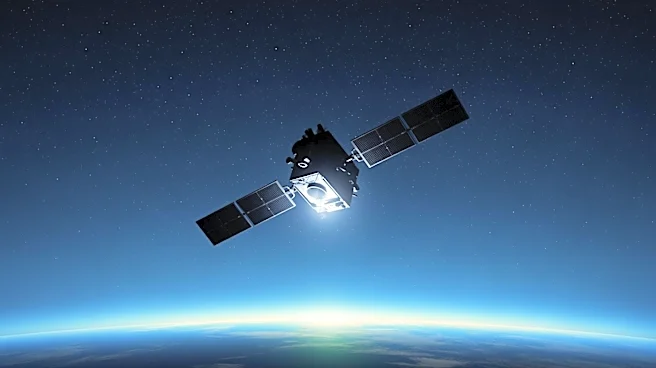
NASA's upcoming Nancy Grace Roman Space Telescope is poised to revolutionize the study of neutron stars, the dense remnants of massive stars that have exploded. Utilizing gravitational microlensing, the telescope will detect these elusive objects by observing
how their gravity bends and brightens the light from distant stars. This method allows for the identification and study of neutron stars that are otherwise invisible due to their dimness and isolation. The Roman Space Telescope's advanced capabilities will enable it to measure both the increase in brightness and the subtle shift in the background star's position, providing a more precise way to study these stellar remnants.
Why It's Important?
The ability to detect and study neutron stars using the Roman Space Telescope is a significant advancement in astrophysics. Neutron stars are key to understanding the life cycles of massive stars and the dynamics of our galaxy. By providing direct mass measurements, the telescope will help solve long-standing mysteries about the mass distribution of neutron stars and black holes, and the boundary between the two. This research could lead to breakthroughs in our understanding of stellar evolution and the forces at play in the universe. The findings may also inform future studies on the formation and behavior of other cosmic objects.
What's Next?
As the Roman Space Telescope begins its mission, astronomers anticipate uncovering a large sample of isolated neutron stars, shedding light on a population that has remained hidden from previous surveys. The telescope's Galactic Bulge Time Domain Survey will scan millions of stars, primarily aimed at identifying exoplanets, but also opening new frontiers in astrophysical research. The data collected will be crucial for refining models of stellar evolution and understanding the dynamics of our galaxy. The anticipated discoveries could transform our understanding of the universe, revealing previously hidden neutron stars and opening a new chapter in the study of stellar remnants.