







What's Happening?
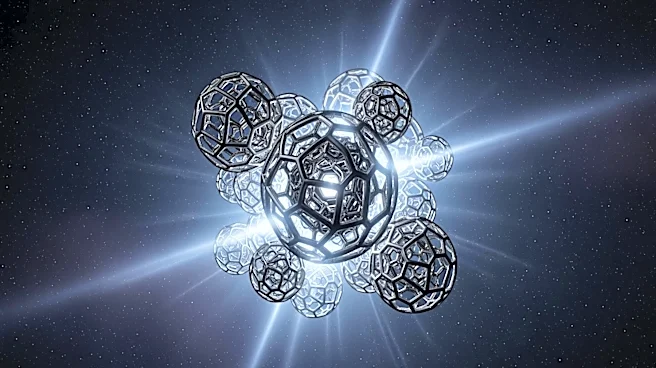
Researchers at Penn State, in collaboration with other institutions, have proposed that ultraheavy atomic nuclei may be responsible for some of the highest-energy cosmic rays detected on Earth. This hypothesis aims to explain the origins of particles
like the 'Amaterasu particle,' detected in 2021, which ranks among the most powerful cosmic-ray events. The study, published in Physical Review Letters, suggests that these ultraheavy nuclei lose energy more slowly than lighter particles, allowing them to reach Earth with extreme energy levels. The research could help identify cosmic sources capable of launching such particles, potentially involving massive star deaths or neutron-star mergers.
Why It's Important?
Understanding the origins of ultrahigh-energy cosmic rays is crucial for astrophysics, as these particles provide insights into some of the universe's most powerful phenomena. The identification of ultraheavy nuclei as potential sources could reshape the search for cosmic-ray origins, focusing on extreme astrophysical events like black hole formations and gamma-ray bursts. This research not only advances scientific knowledge but also enhances our understanding of the universe's most energetic processes. The findings could influence future observational strategies and theoretical models in astrophysics, impacting how scientists study cosmic phenomena.
What's Next?
Future observatories, such as the proposed AugerPrime and Global Cosmic Ray Observatory, may test the hypothesis by looking for predicted signatures of ultraheavy nuclei. Additional theoretical work on cosmic explosions involving black holes and neutron stars could further elucidate the origins of ultrahigh-energy cosmic rays. The research team plans to continue simulations to refine their understanding of how these particles travel through space. As new data becomes available, scientists will be able to assess the contribution of ultraheavy nuclei to the overall population of cosmic rays, potentially leading to breakthroughs in astrophysics.